by Supreme Lending | Aug 1, 2024

When someone asks if it’s possible to add renovation costs to mortgage, the simple answer is yes! When buying a home, people dream of finding the perfect property that checks off all their boxes. However, sometimes the ideal property may need a little work to become that dream home. This is where renovation loans come in. By adding renovation costs to your mortgage, you can finance both the purchase of your home and the necessary improvements into a single loan. Read on to learn more about renovation loan options, benefits, and frequently asked questions.
Types of Renovation Loans
There are several loan programs to consider that can add renovation costs to your mortgage:
- FHA 203(k). This renovation program is an FHA loan, insured by the Federal Housing Administration. There are two options depending on the extent of the home remodel or repairs. The Limited 203(k) is for more minor updates that ensure the home is safe and functional and can include basic cosmetic improvements. The Standard 203(k) option offers more flexibility and larger scale renovations, such as structural foundation or adding square footage. Only primary residences are eligible. Click here to read more about the FHA 203(k) Renovation Loan.
- Fannie Mae HomeStyle®. This is a Conventional loan option to add renovation costs to mortgage. It includes home improvements that are permanently affixed to the property and add value, including luxury items such as high-end flooring, decks, fencing, a pool, etc. Unlike the FHA 203(k), this program can also be used toward qualified second homes and investment properties.
- VA Renovation. This renovation loan is for eligible military Veterans, active duty personnel, and some surviving spouses. It offers the same benefits as VA loans, such as no down payment requirements and lower closing costs, plus the ability to include certain home repairs into a single, affordable mortgage.
- Supreme Dream 203(k). Another exciting renovation loan program that Supreme Lending offers is the FHA 203(k) loan, as noted above, combined with the Supreme Dream down payment assistance resulting in less upfront costs.
How Renovation Loans Work
- Determine Your Renovation Needs. Assess the scope of your renovation project and obtain estimates from contractors to understand the anticipated costs.
- Loan Application. Apply for a renovation loan with a lender. You will need to provide detailed renovation plans. At Supreme Lending, we have a dedicated construction lending team to support all renovation loans for a smooth process.
- Loan Approval. Once approved, the loan amount is based on the projected value of your home after the renovations are completed.
- Renovation Process. Funds are typically disbursed in stages as the renovation progresses ensuring that contractors are paid, and the work is successfully completed.
- Final Inspection. After the renovations are finalized, a final inspection is typically required to verify that the work meets the loan requirements, and any remaining funds are released.
Frequently Asked Questions
Can I add renovation costs to any type of mortgage?
Not all mortgage types allow for renovation costs to be added. Specific loans, such as the programs listed above, are specifically designed to fund renovations and have additional steps and guidelines to follow.
How are renovation costs disbursed with a renovation loan?
With a renovation loan, funds for the purchase of the property are typically disbursed at closing. The renovation funds are placed in an escrow account to be paid out as repairs are completed.
How are renovation loans approved?
Your lender’s underwriting department will help approve the loan application and make sure all guidelines and requirements are met. This includes reviewing the home’s value after the renovations are made. The renovation schedule and documentation are also evaluated to ensure a seamless process.
Are there limits on the amount someone can borrow for renovations?
Yes. Each loan type has specific limits depending on the program. For example, an FHA 203(k) Limited loan currently has a maximum of $35,000* repair escrow amount to use toward the contractor’s costs and renovation fees. In turn, an FHA 203(k) Standard depends on the property’s FHA county loan limit. For Conventional renovation loans, the maximum renovation cost is typically up to 75% of the after-improved home value.
*Note: The FHA 203(k) Limited options will be increasing its maximum limit for renovation costs to $75,000 on or after November 4, 2024.
Click here for a complete guide to home renovation loans that includes a detailed comparison of FHA 203(k) and Conventional HomeStyle® loans.
Want to learn more about how to add renovation costs to your mortgage? Get started in creating your dream home with the help of Supreme Lending. We’re here to help every step of the way.
by Supreme Lending | Jul 29, 2024

If you’re thinking of buying a home, you may want to consider the possibility of seller concessions to help reduce upfront loan expenses. Imagine having a portion of your mortgage closing costs covered or even getting some essential home repairs taken care of without having to dig into your savings. That’s where seller concessions come in, also known as seller assistance. It can be a significant benefit for both buyers and sellers. In this guide, we’ll explore what seller concessions are, seller assist limits, and frequently asked questions.
What Are Seller Concessions?
Seller concessions are contributions paid by the seller that go toward the homebuyer’s closing costs. These can include closing fees, prepaid expenses, or even home repairs or improvements. These concessions can help lower the amount of money a buyer needs to bring to the closing table, making the home purchase more affordable.
The concession amount can be expressed as a percentage of the home’s purchase price or fixed dollar amount.
Examples of What Seller Concessions Can Cover
Seller concessions can be used for a variety of mortgage and homebuying costs including:
- Loan Origination Fees. Fees charged by the lender for processing the loan application.
- Appraisal Fees. This is the cost of having a home appraised.
- Home Inspection Fees. This is the cost of having a home inspected before closing.
- Property Taxes. Prepaid property taxes may be included in closing.
- Title Insurance. This insurance protects the buyer and lender from potential disputes over ownership.
- Discount Points. Also known as mortgage points, these help pay down the interest rate using upfront costs.
- Home Repairs or Improvements. Costs for necessary repairs identified during the home inspection or agreed-upon improvements before the sale.
How Do They Work?
- Negotiation. Seller concessions are typically negotiated as part of the buyer’s and seller’s purchase agreement. This request can be made with help from a real estate agent.
- Agreement. If the seller agrees to concessions, the specific details are outlined in the contract and must not exceed a specified limit depending on the loan type.
- Appraisal. The agreed-upon concessions cannot inflate the property’s value. Lenders require an appraisal to ensure the property’s market value supports the loan amount, including the concessions.
- Loan Approval. The lender will review the agreement and appraisal. This will ensure that the concessions align with the mortgage program’s guidelines.
- Closing. When the loan is ready to close, the costs are applied to the buyer’s closing costs or other agreed-upon expenses.
Who Benefits from Seller Concessions?
Both the buyers and sellers can benefit!
- Buyers. Concessions can lower the upfront costs needed to buy the home, making it easier to afford the property.
- Sellers. Offering concessions can also make the home more attractive for potential buyers, helping sell the home quicker.
Seller Assistance Limits
Limits on how much a seller can contribute vary depending on the loan type and down payment:
Conventional Loans
- Primary residence and second homes:
- 3% maximum with less than 10% down
- 6% maximum with 10-25% down
- 9% maximum with more than 25% down
- Investment properties:
- 2% maximum regardless of down payment
FHA/USDA Loans
- 6% maximum toward closing costs and prepaid items
VA Loans
- 4% maximum toward prepaid items
- No limit for closing costs or reasonable discount points
Frequently Asked Questions
Can the seller cover the entire down payment?
No. Seller concessions cannot be used for the full down payment. They are typically used for closing costs, prepaid expenses, and other associated fees, while meeting the loan guideline limits.
Does seller assistance affect the loan approval process?
Seller concessions themselves do not affect loan approval, but lenders can consider the impact on the Loan-to-Value (LTV) ratio and may require specific guidelines.
How does it impact the home appraisal?
The home’s appraisal must support the purchase price, including any seller contributions. If the appraised value is lower than the agreed-upon price, the lender may require adjustments.
Can a buyer negotiate for concessions?
Yes! Homebuyers can request this during negotiations. It’s essential to work with a knowledgeable real estate agent to help navigate the process.
How do seller concessions benefit first-time homebuyers?
First-time buyers often benefit from this as they may have limited funds for closing costs and other expenses. Seller assistance is another great way for more people to unlock the door to homeownership!
If you’re ready to start your homebuying journey, your local Supreme Lending team is ready to help! Contact us to learn about your mortgage options and get pre-qualified today.
by Supreme Lending | Jul 26, 2024

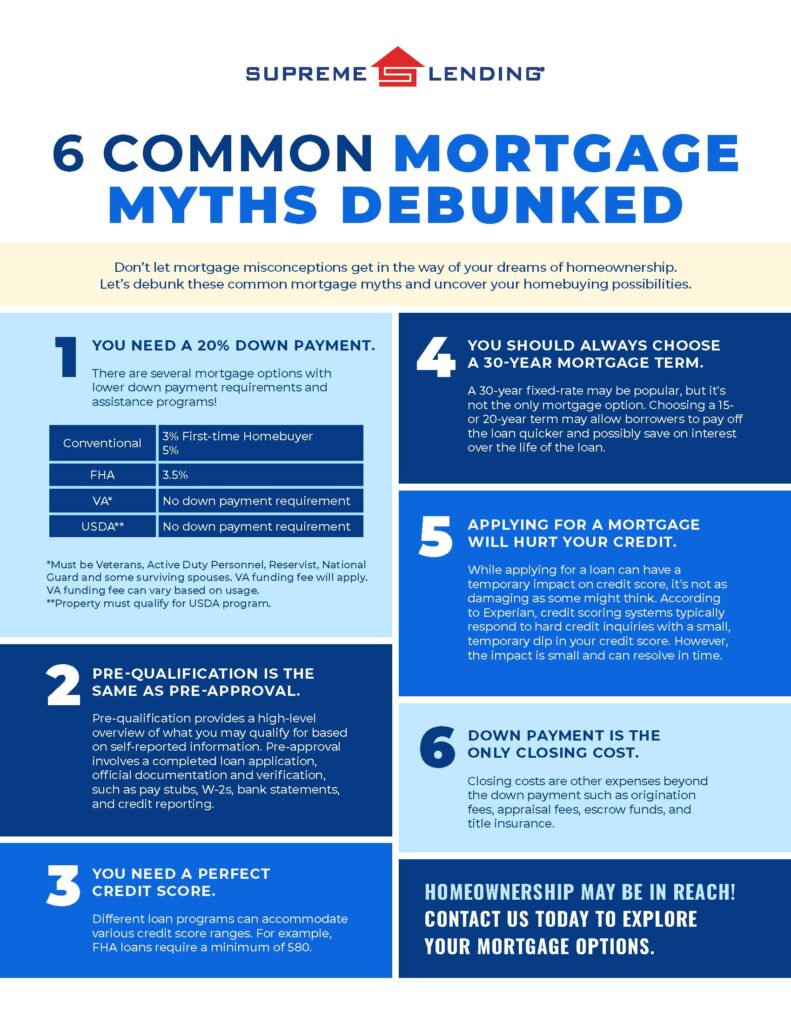
Don’t let mortgage myths get in the way of your dreams of homeownership. Unfortunately, there are several misconceptions about home financing that can make getting approved for a loan seem more difficult than it could be. Supreme Lending is here to set the record straight and help you navigate the steps of the mortgage process with the knowledge you need. Let’s debunk these six common mortgage myths and uncover your homebuying possibilities.
#1 Myth: You Need a 20% Down Payment.
Believing that you must have at least a 20% down payment saved up for a home may be one of the most common mortgage myths of all. When in fact, there are several loan options with lower down payment requirements.
For example, Conventional loans can require as low as 3% down for first-time homebuyers and 5% for repeat buyers. FHA loans require 3.5% down, serving as another affordable option. VA* and USDA** loans are unique in that they require zero down payment. There are also several down payment assistance programs for eligible homebuyers depending on various factors such as income or geographic location.
Why 20% Down?
The 20% myth may be misunderstood because of private mortgage insurance (PMI). If you don’t put down 20% for a Conventional loan, lenders will typically require you to have PMI, which is an added cost to your monthly mortgage payment. It’s important to note that if a borrower reaches a specified equity threshold in their home, mortgage insurance may be removed.
#2 Myth: Pre-Qualification Is the Same as Pre-Approval.
Nope. These terms are often used interchangeably but they are not the same when it comes to where you are in the loan process. Both provide an estimate of how much you may be able to afford for your monthly mortgage payments. However, the key difference between a mortgage pre-qualification and pre-approval is how lenders verify your information.
Pre-qualification is a high-level mortgage estimate based on self-reported information, such as income, debts, and assets. Plus, it’s oftentimes quicker to obtain.
On the other hand, a pre-approval takes a more detailed approach. This involves a completed loan application. Homebuyers must provide thorough documentation of financial history such as pay stubs, W-2s, and bank statements for verification. To get pre-approved, lenders will also verify your credit and employment.
#3 Myth: You Need a Perfect Credit Score.
A recent study found that people either don’t know or significantly overestimate the minimum credit score required for a typical mortgage, reported by Mortgage Professional America. While a higher credit score may help you secure more favorable mortgage rates or qualify for a higher loan amount, you don’t need to have flawless credit.
Different loan programs can accommodate various credit score ranges. For example, FHA loans are designed to make homeownership more accessible by accepting lower credit scores, a minimum requirement of 580.
#4 Myth: You Should Always Choose a 30-Year Mortgage Term.
A 30-year fixed-rate may be one of the most popular mortgages, but it’s not the only one to choose from. Depending on your situation or long-term goals, other mortgage terms may be a better fit. Whether it’s a 15-year term to pay the loan off quicker, or a 20-year term, Supreme Lending offers a wide range of options that can be tailored to match your needs.
#5 Myth: Applying for a Mortgage Will Hurt Your Credit.
While applying for a loan can have a temporary impact on your credit score, it’s not as damaging as some might think. When you apply for a new loan, lenders will pull your credit. This is also known has a hard inquiry for your credit report. According to Experian, credit scoring systems typically respond to hard credit inquiries with a slight, temporary dip in your credit score by a few points. However, the impact is small and can resolve in time.
Additionally, once approved for a mortgage, making on-time monthly payments may strengthen your credit in the long run.
#6 Myth: Down Payment Is the Only Closing Cost.
The down payment is a key part of closing a loan but isn’t the only cash you need to finalize your mortgage. Closing costs are other expenses beyond the down payment such as origination fees, appraisal fees, escrow funds, and title insurance. These costs will be outlined in the closing disclosure.
In addition, some lender programs allow borrowers to buy discount points to reduce their interest rate. This is essentially buying down the rate to save in interest over time. One discount point would equal 1% of the loan amount and would be included as a closing cost.
Understanding the Mortgage Process
Buying a home is one of the most significant purchases you can make. It’s crucial you’re properly informed about the loan process. By debunking these common mortgage myths, we hope to empower you with the knowledge needed to make informed decisions.
At Supreme Lending, we’re dedicated to providing personalized service and expert guidance throughout your homebuying journey. If you have any questions or want to explore your mortgage options, contact us today!
*Must be eligible Veterans, Active Duty Personnel, Reservist, National Guard, or qualifying surviving spouses. VA funding fee will apply. VA funding fee can vary based on usage.
**Property must qualify for USDA program.
by Supreme Lending | Jul 18, 2024
When it comes to securing a mortgage, a key factor that lenders consider when evaluating a borrower’s lending capacity is Loan-to-Value (LTV) ratio. Understanding mortgage LTV, how it’s calculated, and how it can impact your mortgage can help you make informed decisions during the homebuying process. Let’s dive into the details of LTV ratios and why they matter.
What Is Loan-to-Value (LTV) Ratio?
The LTV ratio is a financial term used by lenders to assess the risk of a loan. It compares the loan amount to the appraised value of the property being purchased or refinanced.* The LTV ratio is expressed as a percentage, demonstrating how much of the property’s value is being financed through the mortgage.
*By refinancing an existing loan, total finance charges may be higher over the life of the loan.
How Is Mortgage LTV Calculated?
The LTV ratio is calculated using the following formula:
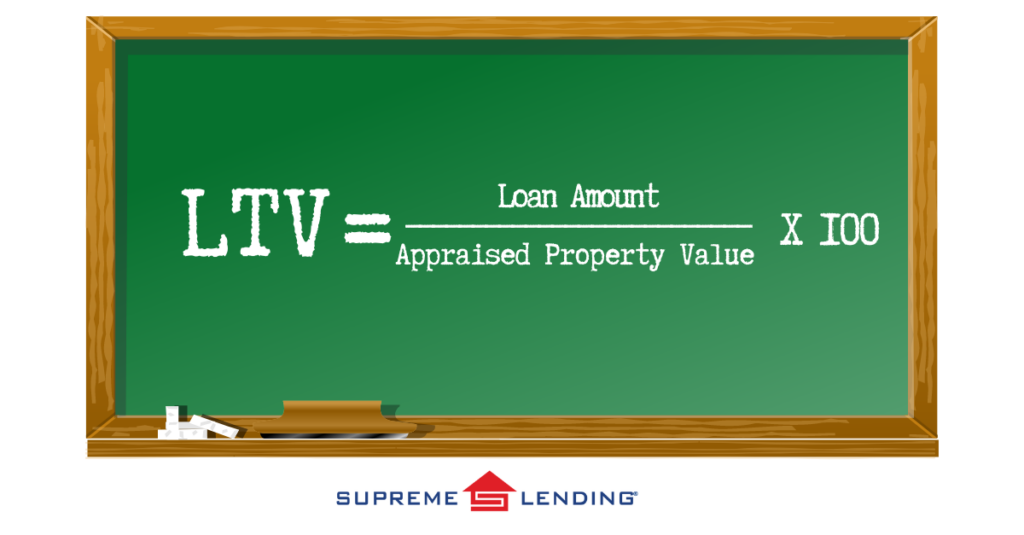
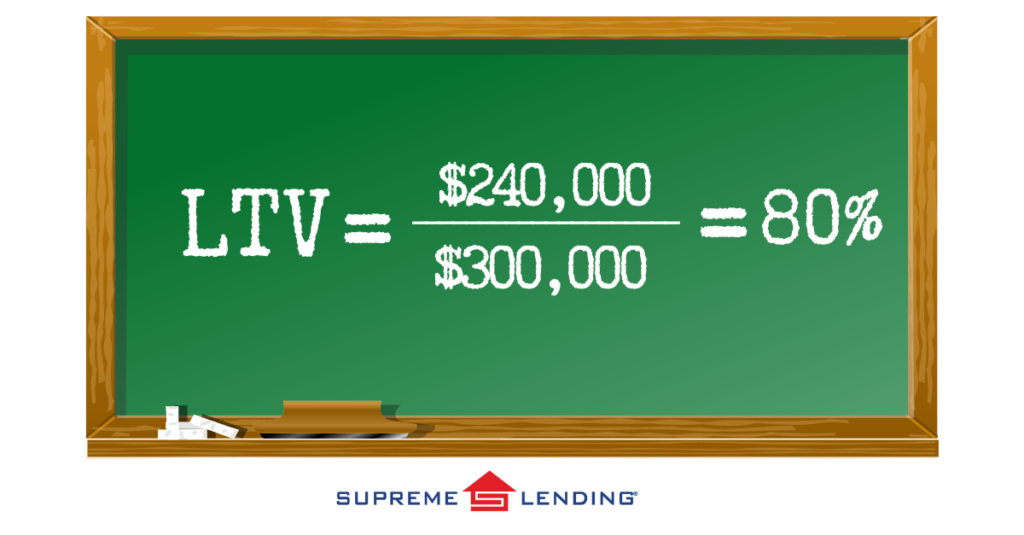
For example, if you’re purchasing a home with an appraised value of $300,000, and you’re borrowing $240,000, the mortgage LTV would be 80%:
How LTV Relates to Mortgage and Homebuying
LTV ratios play a crucial role in the mortgage approval process. Lenders use LTV to determine the level of risk associated with a loan. A lower LTV signifies lower risk, as the borrower has more equity in the property. Consequently, a higher LTV indicates higher risk for the lender, as the borrower has less equity.
How to Measure Mortgage LTV Ratios
A fair LTV ratio is typically 80% or lower. An LTV ratio of 80% or less is favorable because it often means the borrower is not required to pay for private mortgage insurance (PMI), which is usually mandatory for higher LTV ratios. PMI protects the lender in case of default but adds extra cost for the borrower.
LTV Requirements by Common Loan Types
Loan-to-Value criteria depends on the type of loan. Here’s a breakdown of common LTV limits to keep in mind:
- Conventional Loans:
- Maximum LTV: 80% to avoid PMI
- With PMI: Up to 97%
- FHA Loans:
- Maximum LTV: 96.5% for borrowers with a credit score of 580+
- VA Loans:
- Maximum LTV: 100% (no down payment required for eligible Veterans)
- USDA Loans:
- Maximum LTV: 100% (no down payment required for eligible rural properties)
Frequently Asked Questions About LTV Ratios
How Can I Lower My LTV?
You can lower your LTV ratio by making a larger down payment or by choosing a less expensive property relative to the loan amount.
Does a High LTV Affect the Mortgage Interest Rate?
Yes, a higher LTV ratio may result in higher rates because it can be seen as a higher risk for the lender. On the other hand, a lower LTV may qualify for lower rates.
What If My LTV is Above 80%?
If your LTV ratio is more than 80%, you may be required to pay mortgage insurance. This adds protection for the lender and an additional cost to the monthly mortgage payment.
Can LTV Ratios Change?
Yes, Loan-to-Value ratios can change over time as you pay down your loan and as the value of your property increases.
Understanding mortgage LTV is important to making informed decisions about your home financing. By knowing how your Loan-to-Value is calculated and its impact toward your mortgage, you can better navigate the homebuying process and know what to expect.
Our experienced and knowledgeable team at Supreme Lending is committed to helping you achieve your dream of homeownership with confidence and ease. Contact us today to learn more about your loan options and get pre-qualified today.
Related article: Mortgage DTI: What Is Debt-to-Income Ratio?
by Supreme Lending | Jul 17, 2024
Download a copy of the refinance checklist here.

If you’re considering refinancing* your mortgage, there are several ways you can prepare beforehand to ensure a smooth, timely transaction. The refinancing process requires careful planning and organization, starting with gathering the necessary documentation. Just like applying for a traditional mortgage, lenders will require several documents to refi your loan. They’ll need to review your existing mortgage, finances, debts, and capacity to repay the loan. Here’s a general breakdown of what you’ll need to prepare along with a refinance checklist.
Understanding Your Goals of Refinancing
To refinance an existing mortgage essentially involves replacing it with a new one. The most important step of refinancing is to understand the outcome of your new home loan. Whether you’re looking to change the loan term, reduce the interest rate, or take out cash from your home equity, using a refinance calculator can help you get an estimate of associated costs and new monthly payment.
Refinance Checklist
When you’re ready to begin the refinancing process, it’s time to collect the documents needed to refinance. These include details to help lenders verify your income, current mortgage, debts, assets, and other documents depending on individual situations. Here’s a refinance checklist of basic documents to help guide you in preparing to refinance.
Income Documents
- Pay stubs, past 30 days
- W-2s, past two years
- Tax returns, past two years, if self-employed
- Profit and loss statement, if self-employed
- Social security, pension, disability, or other income verification, if applicable
Home and Mortgage Documents
- Mortgage statement
- Homeowners insurance declarations page
- Homeowners association (HOA) statements, if applicable
Identification
- Driver’s license or state-issued I.D.
- Social Security card
Debt Statements, If Applicable
- Credit card statements
- Student loan balance
- Car loan balance
- Personal loan balance
- Home equity loan
Asset Documents
- Bank statements (checking and/or savings accounts)
- Investment account statements
- Retirement account statements
- Proof of any large deposits or gift funds, if applicable
- Other asset statements
Other Situational Documents, If Applicable
- Bankruptcy documentation
- Divorce decree
- Child support or alimony payments
- Credit or employment gap explanation letter, if requested
- Proof of any rental income collected from investment properties
Simplify Your Refinancing with Supreme Lending
Navigating the refinancing process may seem overwhelming at first, but with Supreme Lending by your side, our experienced mortgage professionals can help guide you every step of the way. From ensuring you gather all necessary documents on the refinance checklist to providing timely updates on your loan status, we’re committed to providing a seamless mortgage experience.
Ready to take the next step in refinancing? Contact your local Supreme Lending branch to get started.
*By refinancing an existing loan, total finance charges may be higher over the life of the loan.