
by suprememarketing | Feb 18, 2026
When planning for retirement and managing home equity, two terms often come up: title and reverse mortgages. While they may sound technical, both play an important role in helping homeowners—especially older adults—understand their rights and options.
What Is a Title?
A title is a legal document that shows who owns a property. If your name is on the title, you are the legal owner and can make decisions about selling, transferring, or refinancing your home.
Forms of title ownership may include:
- Sole ownership – One person’s name is on the title.
- Joint tenancy – Two or more people own the home equally, with rights of survivorship.
- Tenancy in common – Owners may hold unequal shares, and ownership can be passed to heirs.
- Community property – Married couples share ownership equally in certain states.
Your choice of title can affect what happens to your home if you sell, pass away, or apply for a reverse mortgage.
What Is a Reverse Mortgage?
A reverse mortgage is a loan available to homeowners aged 62 or older that allows a portion of home equity to be converted into loan proceeds. Unlike a traditional mortgage, you are not required to make monthly mortgage payments. Instead, repayment typically occurs when you move out of the home, sell it, or the last borrower passes away.
Key points to know:
- You remain the owner of your home and keep your name on the title.
- You are still responsible for property taxes, homeowners insurance, and home maintenance.
- The loan balance grows over time and is repaid from the sale or refinance of the home.
Why Title Matters with Reverse Mortgages
The way your home is titled may affect who can apply for and remain on a reverse mortgage. For example:
- If both spouses want to be borrowers, both names should appear on the title.
- If only one spouse is on the title, the other may not have the same protections.
- Updating or reviewing your title before applying can help prevent complications.
Is a Reverse Mortgage Right for You?
Reverse mortgages are not for everyone, but they may be an option for some homeowners. They can provide flexibility in retirement planning, such as:
- Accessing loan proceeds for living expenses.
- Using funds for healthcare or long-term care costs.
- Paying off an existing mortgage, which can reduce required monthly expenses.
- Staying in the home while using available equity.
Whether this option is right for you depends on your financial goals, family needs, and how your title is structured.
A reverse mortgage can be a powerful tool in retirement, but the details of your title can impact eligibility and protections. If you’re weighing your options, connect with our team for clear, personalized guidance.
Disclaimer
This material is for educational purposes only and should not be considered legal, tax, or financial advice. Please consult your own advisors. This information is not from HUD or FHA and has not been approved by any government agency. Borrowers must continue to pay property taxes, homeowners insurance, and maintain the home. Failure to do so may result in foreclosure. Loan proceeds from a reverse mortgage are not considered income and may affect eligibility for certain government benefits. Licensing disclosures vary by state. Please ensure the required company NMLS ID, address, and license information appear at the bottom of your published blog.

by Supreme Lending | Nov 19, 2024

Refinancing* your mortgage may be a strategic financial move that may unlock potential savings, but a common question for homeowners is, how soon can you refinance? Timing is everything. Whether you’re looking to lower your monthly mortgage payments, pay off your home loan quicker, or tap into your home equity for extra cash, knowing when to refinance is important. Let’s dive into the basics of refinancing, how soon you can refinance depending on the loan type, and how to determine the ideal time to consider the option.
Understanding the Basics of Refinancing
Refinancing involves taking out a new mortgage with different terms and using it to pay off your existing loan. The process may result in various benefits:
- Lower Interest Rates. If market conditions cause rates to drop since you purchased your original home loan, refinancing at a lower rate may lead to significant savings over the life of the loan.
- Reduce Monthly Payments. Securing a lower interest rate or a longer loan term may also decrease your monthly mortgage payments.
- Shorter Loan Term. If you can pay off your mortgage much sooner due to an increase in income, for example, it may make sense to refinance into a shorter term.
- Switch Loan Type. If you initially choose an Adjustable-Rate Mortgage, also known as an ARM loan, you may be able to refinance into a fixed-rate loan before the ARM rate adjusts. This may save you interest costs in the long run.
- Cash Out on Your Equity. When refinancing, you might opt for a cash-out refi loan. This allows you to tap into your equity, which is the portion of your home’s value that is yours.
- Payoff Higher-Interest Debts. You can use the cash from your equity to pay other debts such as high-interest credit cards, car loans, or student loans.
- Eliminate Private Mortgage Insurance. In some cases, you may have to pay a monthly fee for mortgage insurance. Once you reach a certain equity threshold, some lenders allow you to remove the private mortgage insurance by refinancing.
Timing Guidelines Based on Loan Type
The timing for when you can refinance your home depends on the lender and type of loan. It’s common for mortgage refinances to require a waiting period, or a seasoning period. Here are some general guidelines on how soon you can refinance a mortgage:
Conventional Loans
For conventional loans, most lenders require at least six months from your original closing date before you can refinance. This waiting period allows lenders to assess your payment history and ensure that you’re not a high-risk borrower. If you use another lender to refinance, you may be able to do a rate-and-term refinance without a seasoning period.
FHA Loans
For FHA loans, which are insured by the U.S. government’s Federal Housing Administration (FHA), you may be able to get an FHA Streamline Refinance. This simplifies the process and requires less documentation. However, you can’t get a streamline refinance until after 210 days from the closing date. You must also have made at least six months of on-time payments.
VA Loans
Similar to FHA, VA loans also offer a streamlined refinancing option known as an Interest Rate Reduction Refinance Loan (IRRRL). You’ll have to wait 210 days from the closing date of your existing VA loan and make six consecutive on-time payments to be eligible.
USDA Loans
These types of loans for rural areas are similar to those of FHA and VA loans. You’ll typically need to wait for 180 days or 12 months (depending on the type of refinancing) and establish a history of making on-time payments for the past six months to one year depending on the program.
Cash-Out Refi Loans
Additionally, how soon can you refinance with a cash-out refi? For this option, you typically need to have occupied the home as a primary residence for at least 12 months.
Why Timing Matters
Prepayment Penalties and Other Fees
A mortgage prepayment penalty is a fee charged by lenders if you pay off your mortgage early. Essentially, this helps compensate lenders for the interest income they lose when the loan is paid off early. When refinancing, it’s important to know if your current mortgage has a penalty or other fees associated to paying off the loan early. The cost of the fee may outweigh the benefits of refinancing.
Down Payment Assistance
Additionally, if you used down payment assistance for your current mortgage, check the terms of that aid. For some programs, refinancing too soon might require you to repay the assistance amount. Other programs may even require repayment of the down payment assistance amount when you refinance regardless of how long you’ve had the loan. This could impact any potential savings from refinancing.
Best Practices and Considerations
When deciding whether it’s a good time to refinance, here are a few things to keep in mind:
- Interest Rates. Monitor the rate and market trends if your primary goal is to refinance with a lower interest rate. You can always reach out to your local loan officer at Supreme Lending to help determine what your potential refinance rate may be.
- Closing Costs. Just like a traditional mortgage, refinancing includes closing costs that can range from 2% to 6% of the loan amount. Be prepared so you’re not surprised at the closing table.
- Break-even Point. Calculate the break-even point by determining when the costs of refinancing will be outweighed by the potential savings. Basically, it’s when your investment in refinancing will start to pay off.
- Loan Term. Consider whether you want to shorten your loan term to save on interest over the life of the loan or extend it for potentially lower monthly payments.
- Credit Score. A stronger credit score may qualify you for more favorable rates, so it’s worth monitoring your credit and making regular, on-time payments.
- Financial Goals. One of the most important aspects of refinancing is to make sure that a refinance aligns with your short- and long-term financial goals. Are you looking to minimize other debts, invest in renovations, or change your loan type?
Is Now the Right Time to Refi?
So how soon can you refinance your mortgage? Ultimately, it comes down to the loan-specific guidelines and your personal financial goals. It’s essential that you are well-informed, understand the refinancing process, and know all the factors that will go into your new refinanced loan. At Supreme Lending, we’re committed to helping you navigate your refinancing journey with ease and confidence.
*By refinancing an existing loan, total finance charges may be higher over the life of the loan.

by Supreme Lending | Nov 7, 2024
For aspiring homeowners and first-time buyers, many questions can arise about the mortgage process. What credit score do you need to qualify? How much down payment is required? Answers are based on several factors including the property, purchase price, and, most importantly, the mortgage type.
Here’s a breakdown to simplify the numbers and help you understand what you need to open the door to your dream home depending on common mortgage types: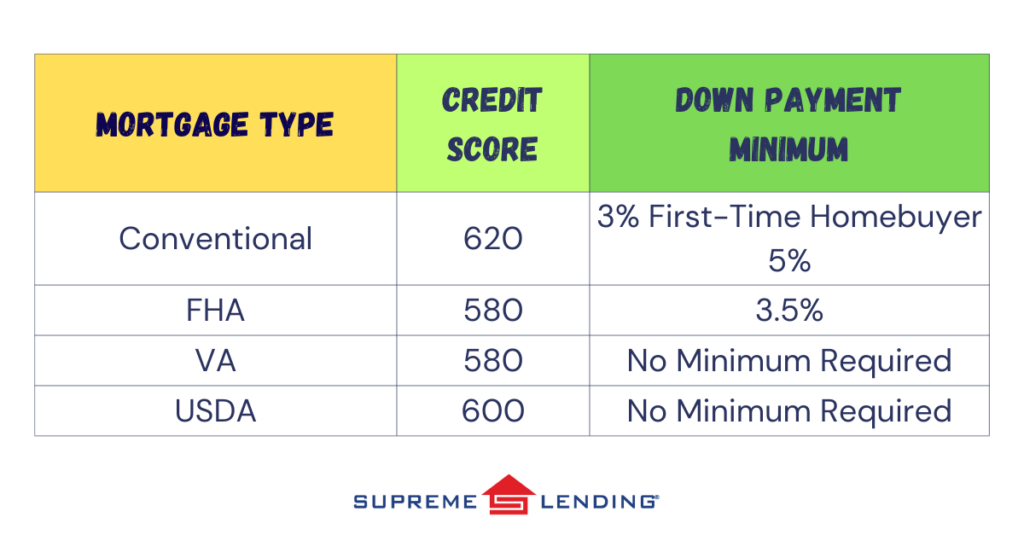
What Is a Credit Score?
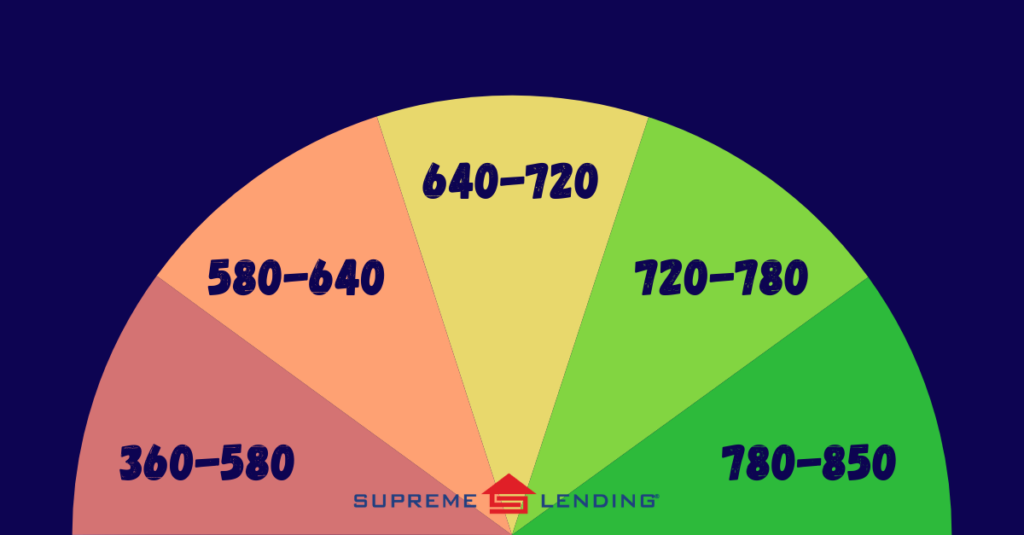
Commonly determined by FICO® score, credit scores are calculated using the borrower’s financial background information such as payment history, credit utilization, length of credit history, types of credit in use, and recent credit behavior. The average credit score in the United States in 2023 was 715, according to Experian data.
Down Payment Assistance Options
If a homebuyer doesn’t have the required minimum down payment or would like to access more financing, Supreme Lending offers several down payment assistance options for qualified buyers. This can also help first-time buyers open the door to homeownership. Guidelines and eligibility vary depending on the program. For example, the Supreme Dream program offers down payment assistance in the form of a fully forgivable second loan and requires a minimum credit score of 620. Ask your Supreme Lending Loan Officer about qualified assistance programs.
Understanding credit score and down payment requirements for different types of mortgages is crucial for prospective homebuyers. While each loan type has its own guidelines, maintaining a good credit score and having sufficient funds for upfront costs at closing remains a common denominator for securing favorable terms and interest rates. By proactively managing your credit and staying informed about your options, you can navigate the mortgage process with confidence on your journey to homeownership.
Contact your local Supreme Lending branch to get pre-qualified and learn about your home financing options.

by Supreme Lending | Nov 3, 2024
An Overview of Supreme Lending Credit Score Requirements

When you’re preparing to buy a home, understanding the mortgage credit score requirements is essential. Your credit plays a significant role in determining your eligibility for various loan programs, as well as interest rates you may qualify for. Our goal at Supreme Lending is to provide the smoothest mortgage experience possible, that includes guiding you with transparent information to help you to make an informed, confident decision. Here’s an overview of Supreme Lending’s credit score requirements for common loan programs and frequently asked questions.
Conventional Loans
Conventional loans are popular among homebuyers due to their flexibility and competitive interest rates. As a general rule of thumb, Supreme Lending requires a minimum credit score of 620 for Conventional loans. However, a higher score typically results in securing more favorable rates and terms.
FHA Loans
Insured by the Federal Housing Administration, FHA loans are another common mortgage option –especially for first-time homebuyers or borrowers with lower credit. These loans have more lenient credit score requirements, accepting as low as 580.
VA Loans
For eligible military Veterans and active-duty personnel, VA loans offer affordable options as they don’t require a down payment or mortgage insurance premiums. Like FHA loans, Supreme Lending’s credit score requirement for VA loans is a minimum of 580.
USDA Loans
Guaranteed by the U.S. Department of Agriculture, USDA loans provide affordable financing designed for homebuyers in designated rural areas with no down payment required. In general, Supreme Lending’s credit score requirement for this program is 600.
Jumbo Loans
Jumbo loans are used to purchase high-value properties with a loan amount greater than conforming loan limits, which is $766,550 for one-unit homes in 2024. Due to potential higher lending risk, Jumbo loans typically have stricter qualifications. Supreme Lending has jumbo programs with a minimum credit score of 680, but depending on the loan guidelines, some may require at least a 720 credit score or higher.
Frequently Asked Questions
Now that you have a snapshot of common credit score requirements at Supreme Lending, here’s some more insight on how your credit can impact your mortgage.
How is a credit score determined?
A credit score, often represented by a FICO® score, is a numerical assessment of a borrower’s financial health. It is calculated based on several key factors:
- Payment History: Your record of on-time payments versus late or missed payments.
- Credit Utilization: The amount of credit you’re using compared to your total credit limits.
- Length of Credit History: The duration of time you’ve had credit accounts open.
- Types of Credit in Use. The variety of credit accounts you have, such as credit cards, mortgages, and car loans.
- Recent Credit Behavior. This includes how many new credit accounts you’ve opened recently and credit inquiries.
Combining these factors provides a numerical score to help reflect your creditworthiness.
What qualifies as a generally “good” credit score?
In general, a credit score of 670 to 739 is considered good according to FICO® standards. Scores in this range suggest that you are a responsible borrower with a solid history of managing credit well. 740 or higher is considered very good or exceptional. Remember, a higher the credit score usually results in more favorable mortgage rates and terms.
Additionally, a credit score between 580 and 669 is considered fair. This range aligns with many of the credit score requirements outlined above depending on the loan type. So don’t fall victim to the common mortgage myth that you need perfect credit to qualify for a home loan.
What’s the difference between a soft credit pull and hard credit pull?
When applying for a mortgage, lenders need to pull your credit report. There are two ways to do this:
- A soft credit pull is a credit check that doesn’t affect your credit score. It’s typically used for pre-qualifications or when you check your own credit. Supreme Lending has this option when you get pre-qualified for a mortgage.
- A hard credit pull, on the other hand, occurs when a lender reviews your credit score as a formal credit application during the loan approval process. Hard pulls can temporarily lower your credit score by just a few points. However, there’s no significant impact, which is another mortgage myth to debunk.
Here to Help
Don’t navigate the mortgage process alone! Our experienced and knowledgeable team at Supreme Lending is here to help you understand all aspects of your homebuying journey. From understanding credit score requirements and determining which loan program may work for you to our seamless underwriting process, we help you close your loan with confidence.
Contact us today to get started!
Related articles:
Common Credit Score and Down Payment Requirements by Mortgage Type
FHA Loans vs. Conventional Mortgage: Which One Is Right for You?

by Supreme Lending | Oct 17, 2024
Discover the Program Highlights of an FHA 203(k) Renovation Loan

Are you ready to turn a fixer-upper into your dream home? Whether it’s a home you’ve just bought or already own, renovation loans like the FHA 203(k) program may help you finance both the purchase and necessary repairs or updates all in one mortgage. Plus, the U.S. Department of Housing and Urban Development (HUD) announced that it is increasing the loan amount for Limited FHA 203(k) loans to $75,000 on all FHA case numbers effective November 4, 2024—that’s up from $35,000 which is huge news!
Here’s an in-depth look at how the FHA 203(k) renovation loan works, the differences between the Limited and Standard options, and what types of renovations may be covered.
What Is an FHA 203(k) Loan?
Insured by the Federal Housing Administration, the FHA 203(k) renovation loan allows homeowners to finance the cost of both the property and its renovations in a single loan. Whether you’re purchasing a home that needs updates or making repairs to your current home, this loan program may help make those dreams a reality. It offers the similar benefits of FHA loans for first-time buyers and repeat buyers alike. To qualify, eligible borrowers only need 3.5% down payment and there’s more lenient credit score requirements than other renovation loans.
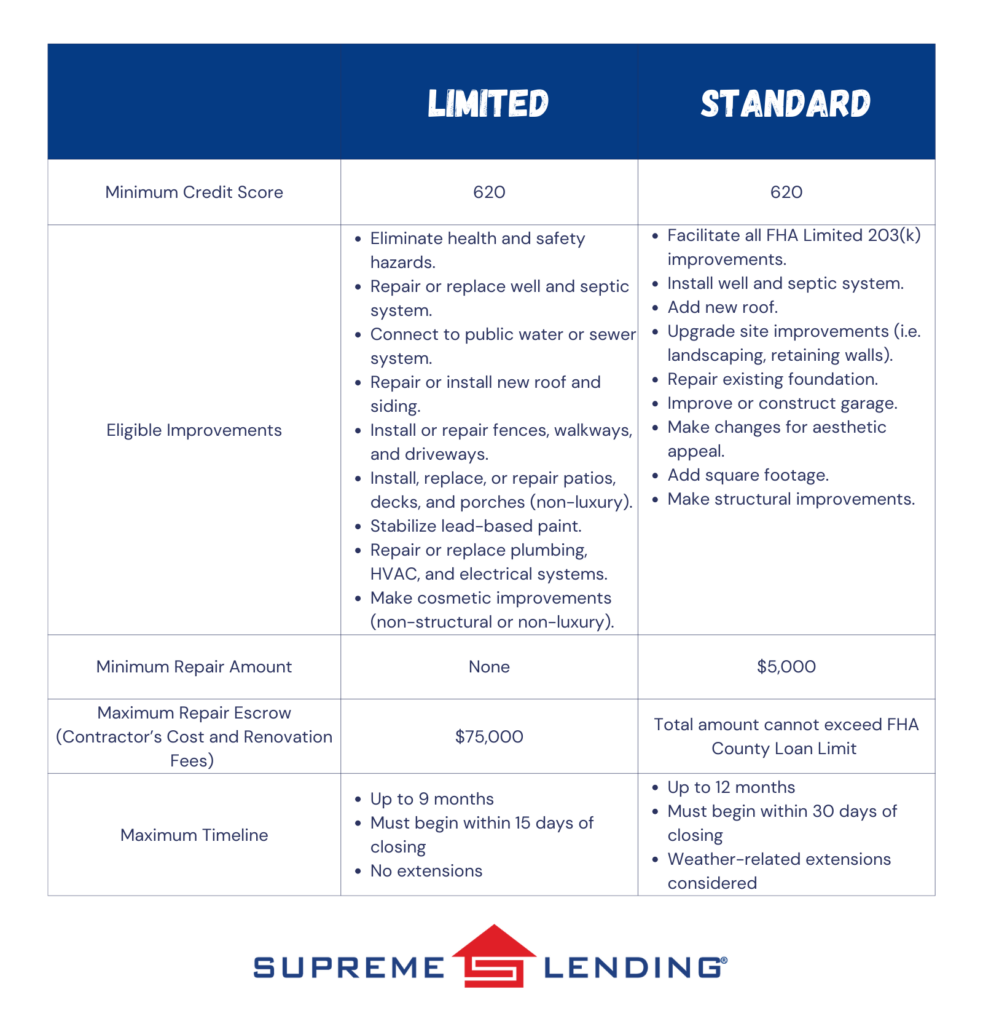
Limited vs. Standard FHA 203(k) Renovation Loan
There are two types of FHA 203(k) loans—Standard and Limited. Each has specific uses and limits depending on the scope of renovations you can make.
Limited FHA 203(k) Loan
The Limited 203(k) option is commonly used for smaller repairs and cosmetic upgrades. As mentioned, the loan amount will increase to $75,000 in November 2024, an exciting enhancement that will help open the door to renovations for more people. This loan covers non-structural projects such as remodeling kitchen fixtures, replacing flooring, painting, and minor landscaping. Unlike the Standard, the Limited program doesn’t require working with an HUD consultant or have a minimum loan amount.
Common Projects the Limited Covers
- Minor remodeling (i.e. updating kitchens or bathrooms)
- Replacing appliances or flooring
- Repainting or refinishing surfaces
- Energy-efficient improvements (i.e. installing new windows or insulation)
- Repairing roofs and gutters
Standard FHA 203(k) Loan
The Standard FHA 203(k) Renovation loan is more ideal for homes needing larger renovations and structural repairs. These may include adding rooms, replacing outdated plumbing or electrical systems, and fixing major structural issues. It has a minimum of $5,000 that must be used for renovations and the total loan amount must be within the FHA County Loan Limit. Because these projects are typically more complex, you’re required to work with an HUD-approved consultant.
Common Projects the Standard Covers
- Structural repairs or additions (i.e. adding on square footage or fixing foundation issues)
- Major systems replacements (i.e. plumbing, electrical, or HVAC systems)
- Roof repairs or replacements
- Modernization and improvements to the home’s function
- Accessibility improvements for people with disabilities
How Does the FHA 203(k) Renovation Loan Work?
The process for applying for an FHA 203(k) loan is similar to a regular FHA mortgage but comes with a few additional steps. Here’s an overview of how this loan program works.
- Find a property. Whether it’s a home you already own and want to refinance* or one you’re planning to purchase, identify a property that needs renovations.
- Get an appraisal. The home appraisal will assess both the home’s current market value as well as it’s “as-completed” value after the renovations are completed.
- Contractor and Estimates. Work with a licensed contractor to obtain the estimated costs for the repairs and improvements.
- Loan Application. You’ll apply for the loan based on the combined cost of the home and repairs.
- Renovation Timeline. Once the loan is approved, the renovation funds are placed into an escrow account and work begins. The renovation timeline can typically range from six months to one year.
*By refinancing an existing loan, total finance charges may be higher over the life of the loan.
FHA 203(k) Combined with FHA 203(h) Disaster Relief Loan
Did you know that eligible borrowers affected by federally declared disaster areas may be able to combine the FHA 203(k) renovation loan with the FHA 203(h) disaster relief loan? This means adding the renovation costs into a new mortgage if your home was destroyed and deemed unlivable. Plus, the damaged property is eligible regardless of the age of the home. It only needs to have been a habitable residence prior to the disaster.
Ready to Rebuild?
At Supreme Lending, we understand how important it is to transform a home into one that truly meets your needs. Whether you’re fixing up a new property or renovating your current home, the FHA 203(k) renovation loan offers an excellent way to finance those improvements. We’re proud to offer both Standard and Limited options to fit the scope of your home projects.
Want to learn more about FHA 203(k) renovation loans or other mortgage options? Contact our team at Supreme Lending today and get pre-qualified!
Looking for other renovation loan options? Read more:
by Supreme Lending | Oct 9, 2024
All You Need to Know About the FHA 203(h) Disaster Relief Loan Program
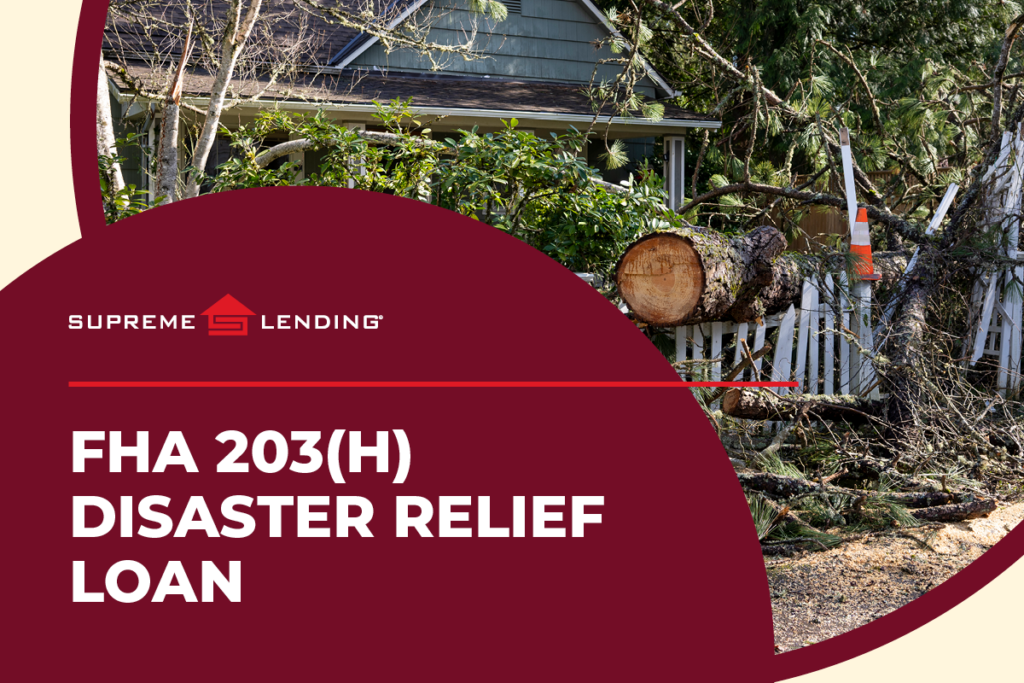
When natural disaster strikes, the devastation it leaves behind can be overwhelming, especially if your home is damaged or destroyed. At Supreme Lending, we know how difficult it can be to rebuild after such destruction. That’s where the FHA 203(h) Disaster Relief Loan may be able to help as an affordable option for those in eligible areas.
If you’ve been affected by disaster and are looking to rebuild or purchase a new home for a fresh start, Supreme Lending is here to help you navigate the challenging time with care and expertise. This guide will walk you through the FHA 203(h) loan, how it works, benefits, and why it may be a valuable program for helping disaster victims get back on their feet.
What Is the FHA 203(h) Disaster Relief Loan?
The FHA 203(h) is a government-insured mortgage program that provides financial assistance to individuals whose homes have been damaged or destroyed in federally declared disaster areas. This is designed to help homeowners and renters alike rebuild or purchase new homes in the wake of devastating events like hurricanes, floods, tornadoes, and wildfires.
What makes the FHA 203(h) Disaster Relief Loan unique is the ability to help make homeownership more attainable after such tragedy by offering flexible guidelines and 100% financing.
How Does FHA 203(h) Work?
The FHA 203(h) Disaster Relief Loan works similarly to other FHA programs but comes with added benefits and provisions specifically for disaster victims. Here’s a breakdown of how it works.
What Properties Are Eligible?
To qualify, your current home must be in a Presidentially Declared Major Disaster Area (PDMDA) and must have been damaged to the point where it is no longer livable. The loan must be secured within one year of the disaster declaration, offering you plenty of time to regroup and take the next step towards recovery.
Program Benefits
- No down payment required. One of the biggest benefits of this program is that there is no down payment requirement for eligible borrowers. This makes it easier to secure financing without the burden of saving for large upfront costs, especially after facing potential hardships caused by a disaster.
- Minimum credit score of 580. While there are still credit parameters in place, the FHA 203(h) offers more lenient requirements than other financing options. This may help borrowers whose credit was negatively impacted due to the natural disaster.
- Available for single-family or FHA-approved condos. The home must be a primary residence – either a single-family home or approved condominium project. This program is not designed for second homes or investment properties but is focused on truly helping homeowners get back on their feet.
- Purchase location flexibility. Through this program, it allows you to purchase a new home anywhere in the United States. The replacement home doesn’t have to be in a designated disaster area.
Combining FHA 203(h) with 203(k) Renovation
The FHA 203(h) program also offers the option to combine with an FHA 203(k) Standard or Limited Renovation loan. This involves adding renovation costs into a single mortgage to cover repairs and remodel projects ranging from minor updates to structural if approved. Plus, the damaged property is eligible regardless of the age of the home. It only needs to have been a habitable residence prior to the disaster.
Ready to Relocate or Rebuild?
Supreme Lending is here to help you move forward and rebuild when disaster strikes. To learn more about the FHA 203(h) Disaster Relief Loan or to go over other mortgage options, contact your local Supreme Lending branch today!
More Resources from the U.S. Department of Housing and Urban Development:
Related Articles: