by Supreme Lending | Jun 26, 2024
Understanding Down Payment Assistance Programs
When it comes to buying a home, one of the most common misunderstandings is that you need at least a 20% down payment. This misconception can discourage potential buyers, especially first-time homebuyers, from pursuing their dream of homeownership. Good news – there are several low and no down payment options, including down payment assistance programs, designed to help people become homeowners without hefty upfront costs. Discover what down payment assistance is, how it works, benefits, and other lower down payment mortgage options.
What Are Down Payment Assistance Programs?
Down payment assistance (DPA) refers to programs designed to provide financial aid to help cover part or all of the down payment and, in some cases, closing costs associated with purchasing a home. These programs can significantly reduce the upfront costs of buying a home and help more people across the country buy a home.
How Does Down Payment Assistance Work?
Down payment assistance programs are often provided by state and local governments, non-profit organizations, or other entities dedicated to promoting homeownership in local communities. DPA can come in various forms, such as grants, forgivable second loans, deferred payment loans, and tax credits. Down payment assistance programs can have specific guidelines, often targeted for first-time homebuyers and lower income areas.
- Grants. These are funds that do not need to be repaid. Essentially, they are a gift to help cover a home’s down payment.
- Forgivable Loans. When a loan is forgivable, a borrower doesn’t need to repay it after a certain time period and agreed upon criteria is met. For example, living in the primary home for a set number of years.
- Deferred Payment. This refers to loans that do not need to be repaid until the home is sold, the borrower refinances, or the mortgage is paid off.
- Tax Credits. Some down payment assistance programs offer mortgage credit certificates (MCCs) that provide a direct tax credit based on the interest paid on the loan.
Common Eligibility Requirements
While loans and down payment assistance vary by lenders and program guidelines, here’s an overview of some general eligibility criteria that may be considered.
- Income Limits. Many mortgage DPA programs have maximum income limits based on family size and location. Some lenders may consider how a borrower compares to the Area Median Income (AMI).
- Credit Score. Like most mortgages, credit score is a major factor. A minimum credit score is typically required, such as 620 for FHA and VA.
- First-time Homebuyers. Several down payment assistance programs are designed specifically for first-time homebuyers or people who haven’t owned a home within the past three years. Homebuyer education may also be included with the program as well.
- Primary Residence. In general, down payment assistance is used toward owner-occupied primary residences.
- Location. Properties may also need to be in a specific geographic area or within a targeted zone for revitalization to qualify.
- Profession. Some down payment assistance programs may also target specific occupations, such as first responders, educators, or healthcare providers. These options help give back to those who serve our communities.
Benefits of Down Payment Assistance
- Affordability. Evidently, down payment assistance can greatly reduce the amount of upfront costs when buying a home. When getting pre-qualified for a DPA program, you’ll be able to determine the right programs and potential savings.
- Increased Accessibility. Many people who might not have qualified for a traditional mortgage due to lack of savings, may qualify using down payment assistance. This helps open more doors to homeownership in your community.
- Flexibility. Down payment assistance typically can be combined with various loan types, including FHA, VA, and USDA. These typically already have lower down payment requirements to begin with. Work with an experienced, knowledgeable loan officer to discuss your options and understand what you may qualify for.
Types of Assistance
Local and State Bond Programs
Many local, regional, and state governments offer down payment assistance programs. Supreme Lending is proud to partner with these types of organizations to provide a wide range of DPA options across the country. Examples include statewide programs through the Texas State Affordable Housing Corporation (TSAHC) or California Housing Financing Agency (CalHFA), and more localized options, such as the Orange County Housing Finance Authority’s First-Time Homebuyer program.
Specialized Options
Fannie Mae and Freddie Mac also have down payment assistance options, such as HomeReady® and Home Possible® that offer down payment requirements as low as 3% for Conventional loans.
Supreme Lending’s Down Payment Assistance
Through Supreme Lending’s Supreme Dream 100% financing, no-money-down program, qualified borrowers get a 30-year fixed FHA loan, followed by a fully forgivable second loan to be used toward down payment, closing costs, and pre-paids. A unique feature of this program is that no income limits are required and it can be combined with a 2-1 temporary rate buydown.
Other Low Down Payment Mortgages to Consider
- FHA loans can require down payments as low as 3.5%.
- VA loans offer qualified military Veterans 100% financing, meaning zero down payment required.
- USDA loans, guaranteed by the U.S. Department of Agriculture, offer a zero down payment requirement for properties in eligible rural areas.
- Click here for an overview of common down payment requirements broken down by mortgage type.
At Supreme Lending, we’re always looking for innovative ways to help make homeownership more affordable. Whether it’s through local bond programs, low down payment loans, or our own Supreme Dream down payment assistance.
Contact us today to explore your mortgage options and down payment assistance programs.
by Supreme Lending | Jun 10, 2024
When it comes to financing your new home, choosing the right mortgage is so important – FHA loans, Conventional mortgages, down payment assistance – there are several options to choose from. Each loan program has its own set of guidelines, benefits, and considerations. Comparing loan types can help you make an informed decision of what may fit your needs and homeownership goals. Let’s examine the difference between these two popular options: FHA loans and Conventional mortgages.
What Is an FHA Loan?
FHA loans are mortgages insured by the U.S. government’s Federal Housing Administration (FHA) against borrower default. They are designed to help more people who may not qualify for Conventional loans achieve homeownership. Here are some key benefits of FHA loans:
- Lower Credit Score Requirements. FHA loans typically require a minimum credit score of 580, which is lower than Conventional loans.
- Low Down Payment. One of the most attractive highlights of FHA loans is the low down payment requirement. Qualified borrowers can put down as little as 3.5% of the purchase price, plus there may be options to include down payment assistance.
- Flexible Debt-to-Income (DTI) Ratio. FHA loans allow higher DTI ratios, making it more feasible for borrowers with existing debt to qualify.
- Assumable Loans. FHA loans are assumable, meaning if you sell your home, the buyer can take over your existing FHA loan. This could potentially help save buyers money on closing costs and interest.
- More Lenient Qualification Requirements. In general, the qualification criteria for FHA loans is more moderate compared to Conventional loans. This helps a broader range of borrowers become homeowners.
What Are Conventional Loans?
Conventional mortgages are loans not insured or guaranteed by any government agency unlike FHA. They are offered by private lenders. Borrowers typically need to have a higher credit score and lower DTI ratio.
- Lower Mortgage Insurance Costs. While FHA requires mortgage insurance premiums (MIP) for the life of the loan, Conventional loans typically only require private mortgage insurance (PMI) until the borrower buys down 20% of the mortgage.
- Higher Loan Limits. Conventional loan borrowers can generally qualify for higher loan limits compared to FHA. This can help borrowers purchase more expensive homes.
- Variety of Loan Terms. Conventional mortgages offer a wide range of loan terms and options, including fixed-rate and adjustable-rate mortgages (ARMs), providing more flexibility.
- Potential for Lower Interest Rates. Borrowers with higher credit scores and larger down payments can often secure lower interest rates with Conventional loans than FHA.
- Conforming & Non-Conforming Options. Conforming conventional loans meet the guidelines of government-sponsored enterprises (GSE), such as Fannie Mae and Freddie Mac. While non-conforming loans do not and can have higher loan amounts, including Jumbo loans.
Frequently Asked Questions About FHA vs. Conventional Loans
Which loan is better suited for first-time homebuyers?
FHA loans are often a great option for first-time buyers due to their lower credit score and down payment options. They provide a pathway to homeownership for those who may not initially qualify for a Conventional loan.
Can I refinance* my FHA loan into a Conventional mortgage?
Yes! Borrowers can refinance an FHA loan into a Conventional one. This could potentially eliminate the FHA’s mortgage insurance requirement if you have enough equity in the home and lead to more flexible terms.
*By refinancing an existing loan, total finance charges may be higher over the life of the loan.
Are there income limits for FHA or Conventional?
FHA mortgages don’t have income limits, but they may have loan limits based on the location of the property. Conventional loans don’t have income limits either, however higher income and a better credit profile can help you qualify for a larger loan amount.
How do I decide which loan is right for me?
Take into concentration your credit score, funds you have for down payment and closing costs, and long-term goals. FHA can be ideal for those with lower credit scores, while Conventional loans may be better suited for borrowers with stronger credit profiles. Getting pre-qualified with Supreme Lending can help give you estimated costs for each option.
Whether you opt for an FHA loan or a Conventional, both options provide pathways to owning your dream home. It’s important to review your current situation, consider the benefits of different loan types, and work with a knowledgeable loan officer to help guide you through the mortgage process.
At Supreme Lending, we’re committed to helping you navigate the homebuying process with ease. Contact your local branch to get started today!
by Supreme Lending | May 9, 2024
Learn why FHA loans may be a perfect option for first-time buyers.

While first-time buyers are hunting for their perfect home, they’ll also need to be on the hunt for the perfect mortgage—which may seem more overwhelming and not as enjoyable as touring properties. There are several financing options to choose from and programs available. It’s all about finding the one that fits best. At Supreme Lending, our goal is to provide the guidance you need to make informed decisions and be confident with your loan choice.
In this article, we’re highlighting a mortgage option that is designed specifically to help first-time buyers, FHA loans. Discover the many FHA loan benefits and why this option may be right for you.
Understanding FHA Loans: A Brief Overview
First, what exactly is an FHA loan? The Federal Housing Administration (FHA), a branch of the U.S. Department of Housing and Urban Development (HUD), insures FHA loans, which are issued by approved lenders. This insurance protects lenders against losses if a borrower defaults on their loan, making FHA loans less risky for lenders and consequently more accessible to first-time buyers.
FHA Loan Benefits
1. Low Down Payments.
To help overcome one of the biggest barriers for first-time homebuyers, FHA loans typically require a lower down payment compared to Conventional loans. This makes homeownership more accessible to people who may not have substantial savings or want to pay less upfront costs.
2. Flexible Credit Requirements.
FHA loans are more lenient when it comes to credit, allowing borrowers with lower credit scores to qualify for financing, which is beneficial for those who are still establishing their credit history. See common credit score and down payment requirements here.
3. Assumable Loans.
What does this mean? FHA loans are assumable, which means that if you sell your home, the buyer can take over your FHA loan, potentially offering them a competitive advantage in a rising interest rate environment. Restrictions on assumability may apply.
4. Lenient Debt-to-Income (DTI) Ratios.
DTI compares a borrower’s debt to their monthly income to measure’s their ability to manage monthly mortgage payments. FHA loans often allow for higher debt-to-income ratios compared to Conventional loans.
5. Lower Mortgage Insurance Premiums.
While FHA loans require mortgage insurance premiums (MIP), the premiums are often lower than those of Conventional loans, especially for borrowers with lower credit scores or smaller down payments. In fact, the FHA annual mortgage insurance premium was lowered from 0.85% to 055% in 2023 for most borrowers.
6. Seller Closing Cost Assistance.
Another benefit buyers could take advantage of is negotiating seller concessions to help cover upfront costs. FHA loans can allow sellers to contribute up to 6% toward the buyer’s down payment, appraisal fees, or other associated closing costs.
7. Gift Funds.
Gift funds are given to someone with no expectation of repayment, for example parents gifting their newlywed children money for a down payment. FHA loans allow borrowers to use gift funds from family members or other eligible sources to cover their down payment and closing costs. Note: A gift letter is required to confirm the gift funds.
8. Renovation Loans.
The FHA 203(k) Renovation loan is a home rehabilitation financing option, which allow borrowers to finance both the purchase price of the home and the cost of eligible renovations or repairs into a single loan. This helps buyers afford any necessary improvements and can open their home search to consider fixer-uppers.
9. Streamline Refinancing.
FHA loans offer a streamlined refinancing option, known as the FHA Streamline Refinance. This allows borrowers to refinance their current FHA loan with minimal paperwork and documentation, saving time and money.
10. No Prepayment Penalties.
FHA loans do not have prepayment penalties unlike some traditional mortgages. This allows borrowers to pay off their mortgage early without facing additional fees or charges, which can save money on interest over time.
11. 100% FHA Financing Available.
Did you know Supreme Lending offers two competitive FHA 100% financing options? Through the Chenoa Fund or the Supreme Dream program, these include a 30-year fixed-rate FHA loan paired with a second forgivable loan to be used toward down payment, closing costs, and prepaids.
These benefits make FHA loans an attractive option for first-time homebuyers, offering accessibility, flexibility, and affordability to achieve homeownership.
Ready to get started? Contact Supreme Lending today to learn more about FHA loans or other mortgage services we offer.

by Supreme Lending | Mar 21, 2024

Picture this – you currently own or want to buy a home with good bones, but it needs some TLC. The good news is that you don’t have to handle a home remodel alone. Renovation loans are a great option to help fund home improvements, repairs, and enhancements by rolling the renovation costs into a single mortgage payment. It’s important to understand how renovation or home improvement loans work, types of renovation loan options, and benefits.
What Is a Renovation Loan?
Renovation loans are designed to help borrowers finance home improvement projects that will increase the value of the home. Whether you’re planning a small home makeover or extensive rehab project, a renovation loan combines a traditional purchase or refinance mortgage with the cost of renovations—it is an all-in-one mortgage financing option that covers the upfront costs of large repairs and projects.
Taking on the remodel before moving in can enhance your living space and home functionalities without the pressure of taking out an additional loan or paying out of pocket for costly repairs in the future.
Types of Renovation Loans
When it comes to renovation loans, there are a few options for prospective homebuyers and homeowners to consider based on eligibility, timing, and the scale of the home improvements needed.
FHA 203(k) Renovation
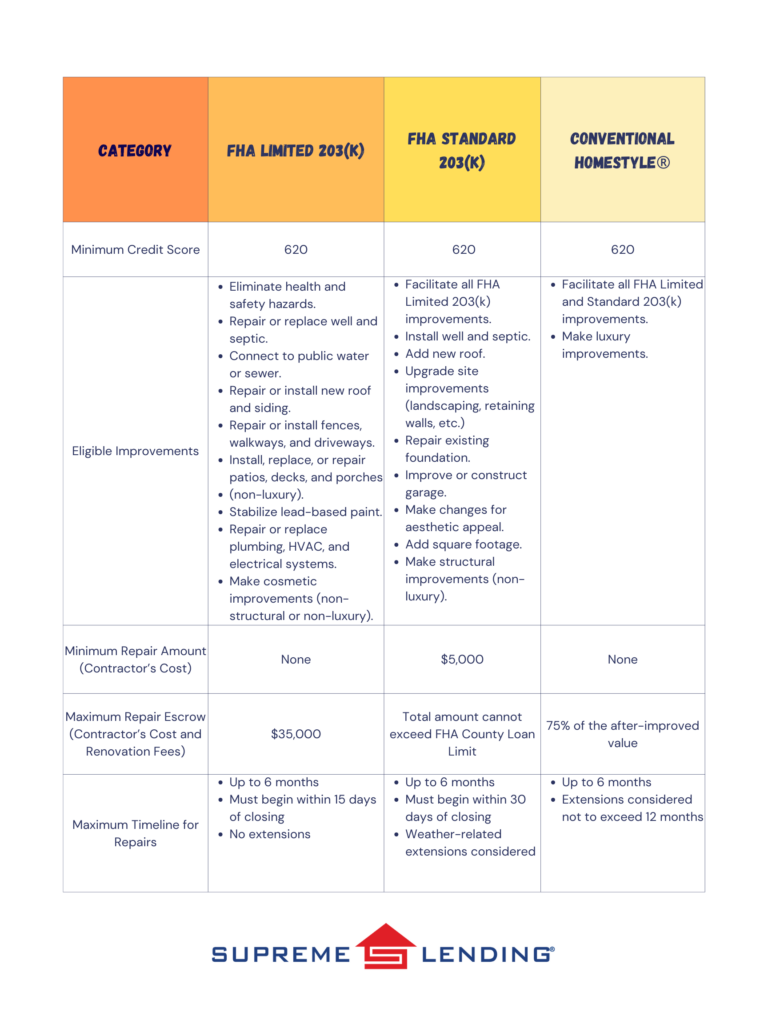
An FHA 203(k) loan, or an FHA rehab loan, is insured by the Federal Housing Administration and provides two options depending on the scope of the home improvement projects, including Limited 203(k) and Standard 203(k), offering different levels of renovation financing.
The minimum down payment for an FHA 203(k) loan is 3.5%. An FHA 203(k) loan covers common basic home improvements and repairs but excludes larger luxury projects and amenities. The Limited option has no minimum renovation amount and can cover up to $35,000 in renovation costs. The Standard has expanded eligible improvements including some structural upgrades and a minimum renovation cost of $5,000. Typically, all renovations must be completed within 6 months.
VA Renovation
The Department of Veterans Affairs (VA) also has a Renovation loan option. A VA Renovation loan offers 100% financing for eligible U.S. Veterans or military personnel to cover a mortgage combined with planned renovation costs into a single loan. Eligible home improvements are similar to FHA 203(k) to cover common upgrades that will make the property safer, healthier, or more functional, excluding luxury projects. VA Renovation loans can finance up to $50,000 in home repair costs.
Conventional Renovation
A Conventional Renovation loan, such as Fannie Mae’s HomeStyle® program, is another financing option that rolls the costs of home renovation projects into a single mortgage and offers more flexibility than a government loan. Conventional Renovation mortgages can cover larger, luxury upgrades, such as creating a high-end bathroom or kitchen with decorative tilework or adding a sparkling backyard pool. The maximum home repair amount is 75% of the home’s post-construction appraised value.
More Benefits of Renovation Loans and Remodeling
- Expand Your Home Search. Prospective homebuyers may have a broader range of properties to choose from, including fixer-uppers, knowing that they could finance custom home upgrades or needed repairs with a Renovation loan.
- Save on Upfront Costs. Home renovation projects can be costly. Funding home remodeling projects with your mortgage could help keep you from tapping into your personal savings and avoid hefty upfront repair costs.
- Grow Your Home Value. Renovation loans are intended to increase the value of your home, which may result in a smart, long-term investment and the potential to build more equity.
- Personalize Your Dream Home. Renovation loans offer an affordable option to help make your design visions come to life and beautify your home to fit your character.
- Enhance Comfort and Livability. Whether it’s expanding a kitchen, adding a bathroom, or creating a home office space, upgrading your home can add modern conveniences and improve your overall well-being.
If you’re looking to enhance your living spaces and potentially increase your property value, a Renovation loan could be the answer to creating the home of your dreams. To learn more about renovation financing or other mortgages, contact your local Supreme Lending branch today.
Related Articles:

by Supreme Lending | Mar 13, 2024

The decision to refinance* your mortgage is a strategic move that can have a profound impact on your financial well-being. There are several types of situations when refinancing might provide specific benefits and unlock potential savings. It’s important that homeowners have a clear idea of the possible outcomes when considering a refinance. Let’s dive into a few of the most common reasons people may refinance, some of which may apply to your situation.
Getting a More Favorable Mortgage Rate
A key reason that homeowners refinance is to get a more favorable mortgage interest rate. This can be done by either securing a lower interest rate than your current mortgage or by switching from an adjustable-rate mortgage (ARM) to a fixed-rate loan. In both cases, this may lead to significant savings over the life of the loan and may even reduce the monthly mortgage payments.
When mortgage interest rates drop lower than your current loan, it’s important to note that there are several additional considerations to be aware of, including fees and upfront costs associated with refinancing as well as the amount of time left on your current loan. Working with a trusted lender that provides personalized, transparent refinancing details and costs will help you make an informed decision for your mortgage needs.
Changing the Terms of Your Loan
Another common reason people refinance is to change the terms of their loan. This may involve extending the length of the loan to lower monthly payments or shortening the loan term to pay off the mortgage quicker. Refinancing to a shorter-term loan may increase your monthly mortgage payment, so it’s important to consider your budget before making this decision.
Switching Loan Type
Some homeowners may refinance to opt for another loan type, for example moving from an ARM to a fixed-rate mortgage. Interest rates—and subsequently monthly mortgage payments—for an ARM can increase or decrease based on market conditions, so borrowers may be more comfortable switching to a fixed-rate mortgage that has a steady interest rate and monthly payment that won’t change.
Another scenario could be borrowers wanting to change from a government loan, such as FHA or VA, to a Conventional mortgage. This could be an effective way to save on some loan costs by removing required fees typically associated with government loans.
Removing a Co-Signer
If you required a co-signer to qualify for a mortgage, you may be able to remove them from the loan by refinancing after improving your eligibility to qualify for a loan by yourself. Not only does this free up the co-signer from their financial obligation, but it may also help you qualify for a lower interest rate on your loan, especially if your credit score improves when the co-signer is removed. This could lead to more favorable loan terms. Homeowners may also want to remove a co-signer in the event of a divorce resulting in one spouse assuming sole ownership of the home and full responsibility for the mortgage.
Removing Private Mortgage Insurance or Mortgage Insurance Premium
For those who put down less than 20% down payment for a home, a common requirement is carrying private mortgage insurance or PMI. This protects the lender in case the borrower defaults on the loan, but it also means an additional monthly cost that can add up over time.
With Conventional mortgages, you don’t have to always refinance to remove PMI. It can be removed after you’ve reached a certain equity threshold in the home—usually 20%. However, some mortgage programs, like FHA loans, require a Mortgage Insurance Premium (MIP) for the life of the loan. An FHA borrower would need to refinance to a Conventional mortgage to remove the MIP cost.
Cashing Out Equity
Finally, another popular way homeowners utilize refinancing is to cash out the equity that’s built up in the home. If you refinance an amount greater than what you owe on your home, you can receive the difference in a cash payment to be used as you wish. For example, you may use this cash to fund home improvements, pay off high-interest debts, or for other large expenses. How you use the cash is up to you.
It’s important to remember that cashing out equity will increase the amount you owe on your home and may also lead to a higher interest rate—factors that should not be overlooked.
As you can see, there are a variety of reasons why homeowners may choose to refinance their mortgage. It’s important to carefully consider your individual circumstances and financial goals before making a decision, as refinancing may not be right for everyone.
For more information on reasons to refinance, or to learn more about any of our mortgage programs and services, reach out to your local Supreme Lending team or contact us today.
*By refinancing an existing loan, total finance charges may be higher over the life of the loan.
by Supreme Lending | Feb 20, 2024
When it comes to buying a home, which could be one of the biggest investments you make, it’s important to understand your financing options. While a Conventional loan is more traditional, FHA loans have seen a rise in popularity due to more flexible guidelines. Let’s dive into a few of the FHA loan benefits and features for homebuyers to consider when choosing a mortgage.
What is an FHA loan?
The Federal Housing Administration (FHA) knows the tremendous value homeownership can bring to people’s lives and communities, which is why it was founded in 1934 to boost home sales and the economy. The government organization offers special mortgage insurance to lenders as an option to help more people who may not qualify for a Conventional or other type of home loan, qualify through an FHA loan.
When applying for a home loan, an FHA loan may be a practical option, especially if you:
- Are a first-time homebuyer.
- Have a lower credit score.
- Want a lower down payment.
- Are refinancing a high-cost mortgage.
FHA loan benefits and features include:
- Low down payment requirements with a minimum of 3.5%. Mortgage insurance is required.
- Credit scores as low as 580 may be accepted.
- Gift funds can be used for 100% of the down payment or closing costs.
- Fixed-rate and adjustable-rate mortgage options are available.
- Flexible qualification guidelines.
Now you might be asking, what properties are eligible for FHA loans? In addition to single family homes, FHA loans could also finance other qualified properties, such as 2- to 4-unit complexes and condos. Properties with an FHA loan will require an FHA appraisal to ensure the living space is safe and meets proper standards.
FHA loans could be a great option as a steppingstone into homeownership. Could these FHA loan benefits match your mortgage needs?
If you’re ready to see if an FHA loan or other home loan program is right for you, Supreme Lending is ready to help. Contact us to get started today!