by Supreme Lending | Oct 31, 2024
All You Need to Know About the VA Loan Funding Fee

Military veterans and active-duty service members have dedicated their lives to serving our country, and Supreme Lending couldn’t be more grateful for their service. When it comes to homeownership, there’s no one more deserving than those who risk their lives to protect our freedom and safety. Supreme Lending is proud to offer the VA loan program. Backed by the U.S. Department of Veterans Affairs (VA), VA loans are designed to give eligible borrowers valuable home financing benefits, including no down payment requirement.
In this article, we’ll explore VA loans, eligibility, and, more specifically, the VA loan funding fee and how it works.
What Is A VA Loan?
A VA loan is a mortgage backed by the U.S. Department of Veterans Affairs. VA financing helps miliary veterans, active-duty service members, and certain members of the National Guard and Reserves become homebuyers. These loans offer several advantages, such as:
- No Down Payment Requirement. One of the biggest benefits of VA loans is that they allow you to purchase a home without a down payment. This makes homeownership for eligible military families more accessible with less upfront costs.
- Competitive Rates. VA loans often come with lower rates compared to Conventional loans, which may save money in interest over the life of the loan.
- No Private Mortgage Insurance. Unlike many Conventional loans that require Private Mortgage Insurance (PMI) when you put less than 20% down, VA loans don’t require this added cost.
- Repeat Buyers. Another unique benefit of VA financing is that it is not only for first-time homebuyers. Repeat buyers are accepted and second homes may be eligible under certain circumstances.
- Low VA Loan Funding Fee. The one-time VA loan funding fee is greatly lower than the typical down payment requirements. Below, we will outline the various funding fee percentages depending on the situation.
- Exemptions for Eligible Borrowers Available. There is an option to be exempt from paying the funding fee for qualified borrowers. For example, veterans who receive compensation for a disability related to their miliary service or active-duty members who received the Purple Heart.
Who Is Eligible for a VA Loan?
To qualify for a VA loan, you must meet specific eligibility guidelines. Generally, you must be a veteran, active-duty service member, or a member of the National Guard or Reserves. When applying for a VA loan, you must have a valid Certificate of Eligibility (COE). This demonstrates your service record and entitlement to VA loan benefits. Some surviving spouses of veterans may also qualify under certain circumstances.
What Is a VA Loan Funding Fee?
While VA loans offer incredible benefits, there is an important cost borrowers need to keep in mind: the VA loan funding fee. The fee helps to lower the cost of the loan for U.S. taxpayers since the VA home loan program doesn’t require down payments or monthly mortgage insurance.
Funding Fee Amounts
The amount of the funding fee varies based on the borrower, type of VA loan they’re getting, and how much down payment is being paid. First-time borrowers typically pay a lower funding fee compared to those who have previously used a VA loan
Click here for a breakdown of funding fees based on loan type.
Paying the Funding Fee
The VA funding fee is paid at closing. There are a few ways you may choose to pay the fee:
- Upfront Payment. Borrowers may pay the fee at closing, in full, which can be included as a closing cost.
- Finance Fee. Borrowers may also choose to roll the funding fee into their loan amount, allowing them to pay it over the life of the mortgage instead of upfront.
- Seller Concessions. In some cases, the seller may agree to cover the funding fee as part of the purchase agreement, providing additional assistance to the buyer.
Explore VA Loans from Supreme Lending
VA loans are a wonderful resource for military veterans and active-duty personnel looking to achieve homeownership. While there’s no down payment requirement, it’s essential to understand the VA loan funding fee. If you’re considering a VA loan or want to learn more about your home financing options, contact your local Supreme Lending branch today!
Related Articles:
by Supreme Lending | Oct 23, 2024

A reverse mortgage* is a unique loan designed to help eligible homeowners and homebuyers aged 62 or older convert some of their home equity into cash. This program may offer greater flexibility and financial independence, especially for those entering retirement. Reverse mortgages allow qualified senior homeowners to tap into their home’s value to meet other financial needs without having to sell their property or make monthly mortgage payments. What is a reverse mortgage, how does it work, and who may benefit from one? Here’s a breakdown.
What Is a Reverse Mortgage?
Reverse mortgages allow homeowners to borrow money using their home as security for the loan. Unlike traditional home loans where the borrower makes monthly payments to the lender, with a reverse mortgage, the lender makes payments to the homeowner. Reverse mortgages are experiencing a surge in popularity as more retirees may be considering them to supplement their retirement income.
How It Works?
The funds received with a reverse mortgage are based on the equity that’s been built in the home. Payments can be made to the homeowner in several ways:
- A lump sum
- A line of credit
- Fixed monthly payments
- A combination of all three options outlined above
The loan does not have to be repaid until the borrower sells or no longer lives in the home. However, the borrower must still meet all loan obligations including living in the house as a primary residence, keeping up with all property payments such as insurance and taxes, and maintaining the home’s condition.
What Can Reverse Mortgage Funds Be Used For?
A reverse mortgage may be a way for seniors to turn their home’s equity into cash to meet their financial needs while maintaining ownership of the property. The funds may serve various purposes, such as paying off other existing mortgages; covering healthcare, taxes, or insurance expenses; funding home renovations; and serving as a safety net for unexpected emergencies.
It may be an ideal option for seniors who:
- Want to stay in their home long-term.
- Need additional income to maintain their quality of life during retirement.
- Have significant equity built in their property but don’t want to sell or cash-out refinance** and take on monthly mortgage payments.
- Need to pay for in-house healthcare.
- Get a later in life silver divorce but want to stay in their home.
- Want to buy a home but are unable to pay all cash.
Frequently Asked Questions About Reverse Mortgage
1. Do I still own my home with a reverse mortgage?
Yes. When you obtain a reverse mortgage, you still retain ownership of your home. Your name remains on the title and the home is yours—just as it would be with any mortgage. You’re still responsible for paying property taxes, homeowners insurance, and maintaining the home.
2. When does the mortgage need to be repaid?
Once you no longer live in the home as your primary residence, the loan balance, including interest and fees, must be repaid. This is usually done by the homeowner or their estate that is selling the house
3. Will I owe more than my home is worth or leave my heirs with debt?
No. A HECM (Home Equity Conversion Mortgage) reverse mortgage is insured by the Federal Housing Administration. This insurance feature guarantees that you will never owe more than the value of your home when the loan becomes due. No debt will be left to your heirs. And if the loan balance is less than the market value of the home, the additional equity is retained by the homeowner or heirs if the home is sold.
4. What types of homes qualify for a reverse mortgage?
Single-family homes, FHA-approved condos, and multi-family homes (up to four units) are typically eligible, as long as the property is the borrower’s primary residence.
Supreme Lending’s Dedicated Reverse Mortgage Team
Want to learn more about reverse mortgages and explore your mortgage options? Supreme Lending is here to help you navigate your home financing. Additionally, in 2024, Supreme Lending launched a dedicated reverse mortgage division led by industry-leading veteran John Luddy NMLS #74875.
To learn more about this unique home financing option, contact John Luddy, SVP of Reverse Mortgage Lending, NMLS #74875 at (860)-883-6783.
*A reverse mortgage increases the principal mortgage loan amount and decreases home equity (it is a negative amortization loan). When the loan is due and payable, some or all of the equity in the property no longer belongs to borrowers, who may need to sell the home or otherwise repay the loan with interest from other proceeds. Lender charges an origination fee, closing costs and servicing fees (added to the balance of the loan). Monthly service fees are not assessed in Texas. The balance of the loan grows over time and Lender charges interest on the balance. The borrower must meet all loan obligations, including living in the property as the principal residence and paying property charges, including property taxes, fees, hazard insurance. The borrower must maintain the home according to FHA requirements. Failure to meet these requirements can trigger a loan default that may result in foreclosure. This material has not been reviewed, approved or issued by HUD, FHA or any government agency. The company is not affiliated with or acting on behalf of or at the direction of HUD/FHA or any other government agency
**By refinancing an existing loan, total finance charges may be higher over the life of the loan.

by Supreme Lending | Oct 17, 2024
Discover the Program Highlights of an FHA 203(k) Renovation Loan

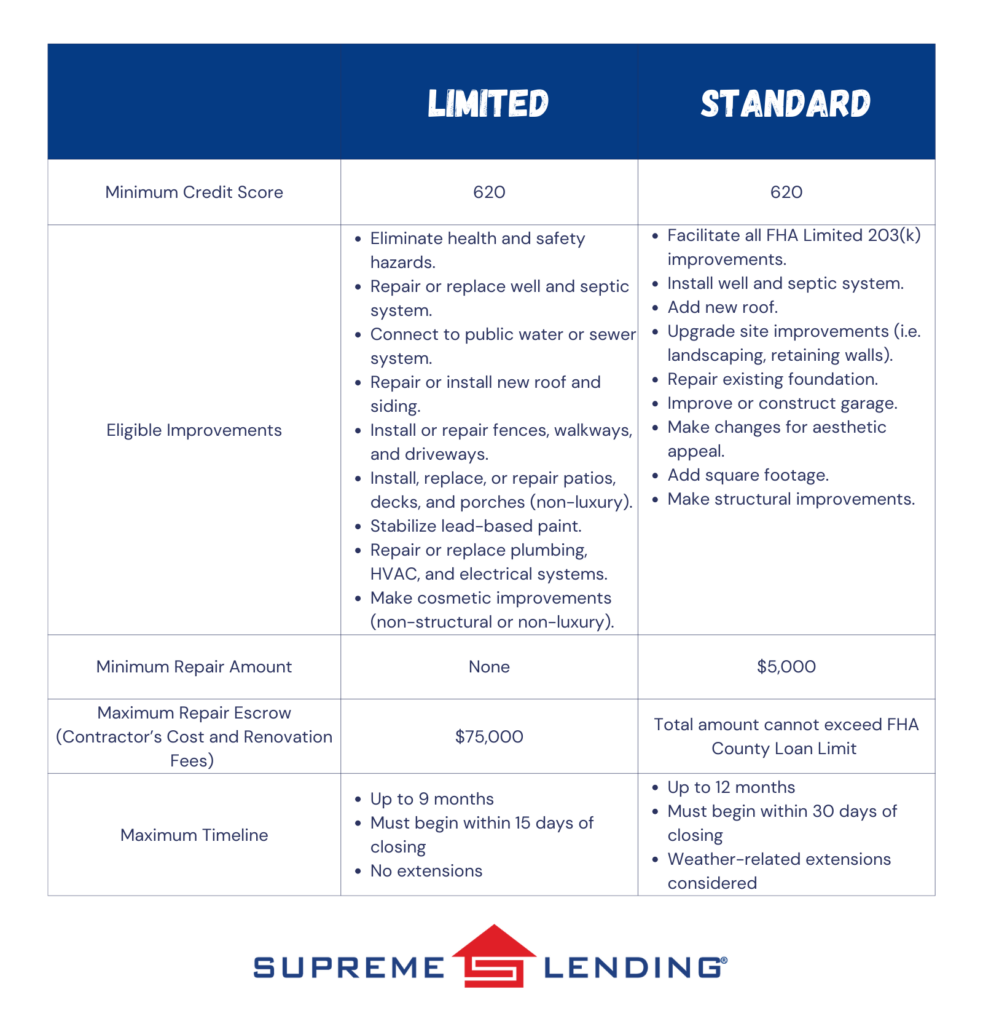
Are you ready to turn a fixer-upper into your dream home? Whether it’s a home you’ve just bought or already own, renovation loans like the FHA 203(k) program may help you finance both the purchase and necessary repairs or updates all in one mortgage. Plus, the U.S. Department of Housing and Urban Development (HUD) announced that it is increasing the loan amount for Limited FHA 203(k) loans to $75,000 on all FHA case numbers effective November 4, 2024—that’s up from $35,000 which is huge news!
Here’s an in-depth look at how the FHA 203(k) renovation loan works, the differences between the Limited and Standard options, and what types of renovations may be covered.
What Is an FHA 203(k) Loan?
Insured by the Federal Housing Administration, the FHA 203(k) renovation loan allows homeowners to finance the cost of both the property and its renovations in a single loan. Whether you’re purchasing a home that needs updates or making repairs to your current home, this loan program may help make those dreams a reality. It offers the similar benefits of FHA loans for first-time buyers and repeat buyers alike. To qualify, eligible borrowers only need 3.5% down payment and there’s more lenient credit score requirements than other renovation loans.
Limited vs. Standard FHA 203(k) Renovation Loan
There are two types of FHA 203(k) loans—Standard and Limited. Each has specific uses and limits depending on the scope of renovations you can make.
Limited FHA 203(k) Loan
The Limited 203(k) option is commonly used for smaller repairs and cosmetic upgrades. As mentioned, the loan amount will increase to $75,000 in November 2024, an exciting enhancement that will help open the door to renovations for more people. This loan covers non-structural projects such as remodeling kitchen fixtures, replacing flooring, painting, and minor landscaping. Unlike the Standard, the Limited program doesn’t require working with an HUD consultant or have a minimum loan amount.
Common Projects the Limited Covers
- Minor remodeling (i.e. updating kitchens or bathrooms)
- Replacing appliances or flooring
- Repainting or refinishing surfaces
- Energy-efficient improvements (i.e. installing new windows or insulation)
- Repairing roofs and gutters
Standard FHA 203(k) Loan
The Standard FHA 203(k) Renovation loan is more ideal for homes needing larger renovations and structural repairs. These may include adding rooms, replacing outdated plumbing or electrical systems, and fixing major structural issues. It has a minimum of $5,000 that must be used for renovations and the total loan amount must be within the FHA County Loan Limit. Because these projects are typically more complex, you’re required to work with an HUD-approved consultant.
Common Projects the Standard Covers
- Structural repairs or additions (i.e. adding on square footage or fixing foundation issues)
- Major systems replacements (i.e. plumbing, electrical, or HVAC systems)
- Roof repairs or replacements
- Modernization and improvements to the home’s function
- Accessibility improvements for people with disabilities
How Does the FHA 203(k) Renovation Loan Work?
The process for applying for an FHA 203(k) loan is similar to a regular FHA mortgage but comes with a few additional steps. Here’s an overview of how this loan program works.
- Find a property. Whether it’s a home you already own and want to refinance* or one you’re planning to purchase, identify a property that needs renovations.
- Get an appraisal. The home appraisal will assess both the home’s current market value as well as it’s “as-completed” value after the renovations are completed.
- Contractor and Estimates. Work with a licensed contractor to obtain the estimated costs for the repairs and improvements.
- Loan Application. You’ll apply for the loan based on the combined cost of the home and repairs.
- Renovation Timeline. Once the loan is approved, the renovation funds are placed into an escrow account and work begins. The renovation timeline can typically range from six months to one year.
*By refinancing an existing loan, total finance charges may be higher over the life of the loan.
FHA 203(k) Combined with FHA 203(h) Disaster Relief Loan
Did you know that eligible borrowers affected by federally declared disaster areas may be able to combine the FHA 203(k) renovation loan with the FHA 203(h) disaster relief loan? This means adding the renovation costs into a new mortgage if your home was destroyed and deemed unlivable. Plus, the damaged property is eligible regardless of the age of the home. It only needs to have been a habitable residence prior to the disaster.
Ready to Rebuild?
At Supreme Lending, we understand how important it is to transform a home into one that truly meets your needs. Whether you’re fixing up a new property or renovating your current home, the FHA 203(k) renovation loan offers an excellent way to finance those improvements. We’re proud to offer both Standard and Limited options to fit the scope of your home projects.
Want to learn more about FHA 203(k) renovation loans or other mortgage options? Contact our team at Supreme Lending today and get pre-qualified!
Looking for other renovation loan options? Read more:
by Supreme Lending | Oct 14, 2024
An Overview of Your Mortgage Checklist
Ready to buy a home but don’t know where to start? We’ve got you covered with what is needed for the loan application process with this basic mortgage checklist! To qualify for a home loan, lenders will need to review several personal and financial documents during the application and mortgage underwriting process. To help streamline the process, it’s helpful to know what all you may need to provide to ensure your mortgage goes smoothly. Once you have completed the loan application and given your intent to proceed with your loan, here’s a general mortgage checklist of required documentation.
Proof of Income
Lenders need to verify that you have a steady income to make your mortgage payments. This is a key part of the loan process, and the documents you’ll need to provide include:
- Pay stubs from the last 30 days (most current)
- W-2s and tax returns from the last two years
Employment Verification
In addition to proof of income, lenders verify your employment to ensure you have stable job security. Be prepared to provide:
- Employment history for the last two years, address any gaps
- Offer letter or contract if you’ve recently started a new job
Credit History
Your credit score plays a big role in determining what loan options and rates you may qualify for. Lenders will pull your credit report to review your creditworthiness. You have options to review your credit beforehand as well.
Proof of Assets
To help determine how much you may be able to afford for a down payment and closing costs, lenders will review your financial assets. At this point in the process, the following will be needed.
- Bank statements from the last two months
- Investment account statements including 401(K), IRAs, stocks, CDs, money market funds, Terms of Withdrawal Retirement, profit share, etc.
- Source of any large deposits, for example if you received mortgage gift funds or sold a large asset
Additionally, any assets used for a down payment, closing costs, and cash reserves must be documented by a paper trail.
Debt-to-Income Ratio
Lenders will review your debt-to-income, known as mortgage DTI, to ensure you can handle additional mortgage payments. This is calculated using:
- Total monthly debt payments, for example credit cards, car loans, student debt
- Monthly gross income including salary, investment income, bonuses, and commissions
Identification
To confirm your identity, you’ll need to provide:
- Government-issued I.D. (valid driver’s license or passport)
- Copy of Social Security card (SSN)
- Residency history, typically for the last two years including landlord information for renters or a mortgage statement if applicable
Other Information Depending on Your Situation
In addition, you may need to provide other documentation depending on your current circumstances.
These could be:
- If paid off a mortgage in last year, need copies of the release of mortgage lien
- If own 25% or more of business, need company tax returns for last two years
- Divorce decree or child support order, if applicable
- Refinance copy of note, Closing Disclosure, and survey
- Relocation Agreement if the move if financed by employer (i.e. buyout agreement, documentation outlining company-paid closing cost benefits)
- Insurance quote
Program-Specific Documents
For government-insured loan programs, there are a few more items you’ll be required to provide:
- FHA: Copy of Social Security card for each applicant and co-applicant
- VA: Original Certificate of Eligibility (COE), copy of DD214 discharge paper, and contact information of nearest living relative
- FHA and USDA: Total household income of all borrowers moving into the new home
Preparing for a Smooth Process
By preparing yourself for a seamless mortgage process, you’re showing lenders you’re organized and ready to move forward. This preparation may help prevent potential delays, reduce stress, and have the majority of items needed to secure your dream home. Bookmark this mortgage checklist to have on-hand when you’re ready to start your homebuying journey.
If you have any questions about what documents are needed or how to get pre-qualified, our team at Supreme Lending is ready to help!
Related Articles:
by Supreme Lending | Oct 9, 2024
All You Need to Know About the FHA 203(h) Disaster Relief Loan Program
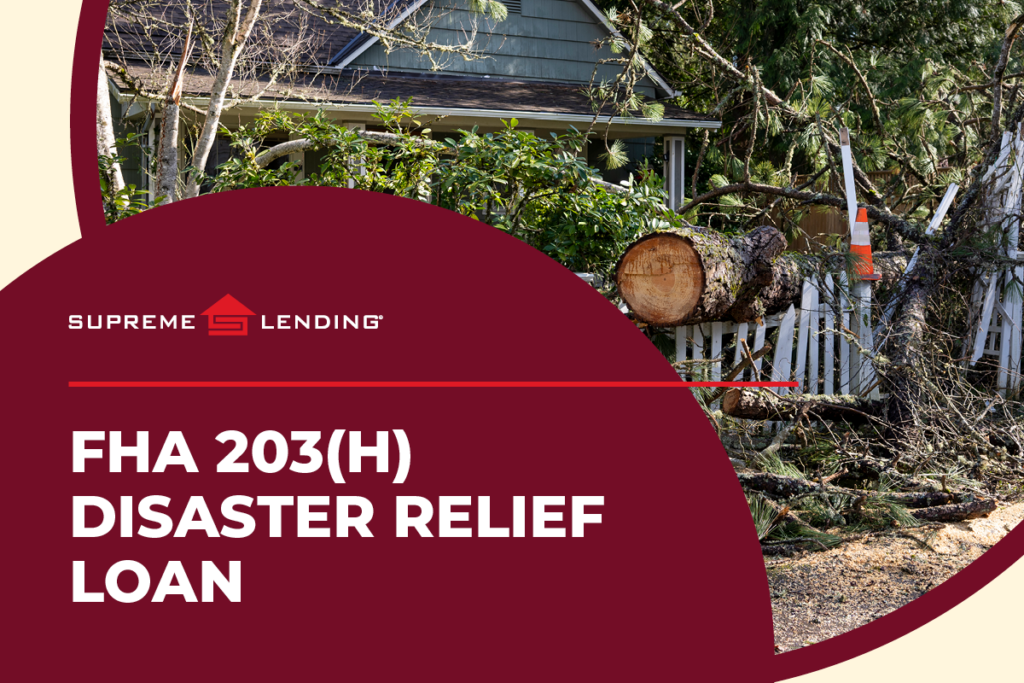
When natural disaster strikes, the devastation it leaves behind can be overwhelming, especially if your home is damaged or destroyed. At Supreme Lending, we know how difficult it can be to rebuild after such destruction. That’s where the FHA 203(h) Disaster Relief Loan may be able to help as an affordable option for those in eligible areas.
If you’ve been affected by disaster and are looking to rebuild or purchase a new home for a fresh start, Supreme Lending is here to help you navigate the challenging time with care and expertise. This guide will walk you through the FHA 203(h) loan, how it works, benefits, and why it may be a valuable program for helping disaster victims get back on their feet.
What Is the FHA 203(h) Disaster Relief Loan?
The FHA 203(h) is a government-insured mortgage program that provides financial assistance to individuals whose homes have been damaged or destroyed in federally declared disaster areas. This is designed to help homeowners and renters alike rebuild or purchase new homes in the wake of devastating events like hurricanes, floods, tornadoes, and wildfires.
What makes the FHA 203(h) Disaster Relief Loan unique is the ability to help make homeownership more attainable after such tragedy by offering flexible guidelines and 100% financing.
How Does FHA 203(h) Work?
The FHA 203(h) Disaster Relief Loan works similarly to other FHA programs but comes with added benefits and provisions specifically for disaster victims. Here’s a breakdown of how it works.
What Properties Are Eligible?
To qualify, your current home must be in a Presidentially Declared Major Disaster Area (PDMDA) and must have been damaged to the point where it is no longer livable. The loan must be secured within one year of the disaster declaration, offering you plenty of time to regroup and take the next step towards recovery.
Program Benefits
- No down payment required. One of the biggest benefits of this program is that there is no down payment requirement for eligible borrowers. This makes it easier to secure financing without the burden of saving for large upfront costs, especially after facing potential hardships caused by a disaster.
- Minimum credit score of 580. While there are still credit parameters in place, the FHA 203(h) offers more lenient requirements than other financing options. This may help borrowers whose credit was negatively impacted due to the natural disaster.
- Available for single-family or FHA-approved condos. The home must be a primary residence – either a single-family home or approved condominium project. This program is not designed for second homes or investment properties but is focused on truly helping homeowners get back on their feet.
- Purchase location flexibility. Through this program, it allows you to purchase a new home anywhere in the United States. The replacement home doesn’t have to be in a designated disaster area.
Combining FHA 203(h) with 203(k) Renovation
The FHA 203(h) program also offers the option to combine with an FHA 203(k) Standard or Limited Renovation loan. This involves adding renovation costs into a single mortgage to cover repairs and remodel projects ranging from minor updates to structural if approved. Plus, the damaged property is eligible regardless of the age of the home. It only needs to have been a habitable residence prior to the disaster.
Ready to Relocate or Rebuild?
Supreme Lending is here to help you move forward and rebuild when disaster strikes. To learn more about the FHA 203(h) Disaster Relief Loan or to go over other mortgage options, contact your local Supreme Lending branch today!
More Resources from the U.S. Department of Housing and Urban Development:
Related Articles:
by Supreme Lending | Oct 7, 2024
Your Helpful Guide to Mortgage Homebuying Tips

Buying a home is one of life’s biggest milestones—a place to make lasting memories, build your future, and truly create a place to call your own. But let’s face it: the homebuying process can feel a bit overwhelming at first. But with the right preparation and guidance, you can navigate your mortgage smoothly and confidently. Whether you’re just thinking about purchasing a new home, buying for the very first time, or a seasoned pro, these 10 mortgage homebuying tips will help you make sense of the process and set you up for success.
1. Save for a Down Payment Early
One of the most important mortgage homebuying tips is saving for a down payment. While some loans may require as low as 3-5% down, the more you have saved, the better. A larger down payment also means a lower loan amount and reduced monthly payment. Working with your local lender early on in the process can help you plan for how much to save for.
2. Don’t Wait to Get Pre-Qualified
Before you even start house hunting, the first step in the homebuying process is getting pre-qualified for a mortgage. Pre-qualification gives you an initial idea of how much you may be able to afford based on information you provide to your lender, including your assets, income, and credit score. Getting a mortgage pre-qualification or pre-approval can also show sellers that you’re a serious, capable buyer.
3. Compare Loan Types
Not all mortgages are the same, so it’s important to understand your options so that you can make an informed decision when it comes to financing your home. Whether it’s a Conventional, FHA, VA, or USDA loan, each comes with its own set of guidelines and down payment requirements. There are also several alternative financing programs including a jumbo loan, bank statement loan, and investment property loans.
4. Explore Down Payment Assistance Programs
Do you know about down payment assistance programs that may be available? These programs are designed to help more people become homeowners with affordable options and flexible guidelines. Depending on the program, assistance can be offered through grants, forgivable loans, deferred payment, or tax credits. Don’t hesitate to ask your lender about these potential opportunities, as they may make a big difference in your homebuying journey.
5. Have Your Documentation Ready
When it comes time to apply for your mortgage, you’ll need to provide a variety of documentation so that your lender can verify your income, employment, and creditworthiness. Common documents include pay stubs, tax returns, bank statements, and W-2s. Having these ready may help speed up the process and avoid delays.
6. Know What’s Included in Your Loan Estimate
After you apply for a mortgage, you’ll receive a Loan Estimate (LE). This document provides you with important information regarding your mortgage application, including the estimated principle payment, interest, taxes, and insurance—also known as your mortgage PITI.
7. Prioritize Both an Appraisal and Home Inspection
During the mortgage process, it’s crucial to understand the appraisal and home inspection—and why you should opt to do both. The appraisal is an assessment of the home’s value that most lenders require. This helps confirm that the loan amount aligns with the property’s market value. Meanwhile, the home inspection evaluates the property’s condition and systems. A home inspector can identify any potential repairs or issues, such as roofing damages, electrical problems, or structural concerns.
8. Avoid Large Purchases or New Credit
It’s also important to hold off on making any large purchases or opening new lines of credit during the mortgage approval process. Big expenses like buying a car or furniture, or applying for a new credit card, may affect your credit score and debt-to-income (DTI) ratio. To keep your loan approval on track, avoid major financial moves until after you’ve closed on your new home.
9. Understand Costs Beyond the Down Payment
While the down payment is a big part of the homebuying process, don’t forget about the additional costs involved in securing a mortgage. Beyond the down payment, you’ll need to consider closing costs, which are other fees to process the loan that typically range from 2-6% of the loan amount. Another potential expense is mortgage insurance, which is required for FHA loans and if your down payment is less than 20% for Conventional.
10. Review the Closing Disclosure
Before officially closing on your home, you’ll receive a mortgage Closing Disclosure (CD). This document provides a transparent summary of all loan details, including terms, projected payments, closing costs, and a transaction summary. Lenders are required to provide your disclosure no later than three days before your scheduled closing. Be sure to carefully review all information to ensure it’s correct to avoid any potential delays.
Supreme Lending Is Here to Help
As you can see, the homebuying process has a lot of moving parts. Keeping these mortgage homebuying tips in mind will help ensure your loan experience is a smooth one.
At Supreme Lending, we’re here to guide you every step of the way. Want to learn more about our mortgage services or ready to start your homebuying journey? Contact your local branch today!