
by Supreme Lending | Jul 21, 2025
For homeowners aged 62 and older, financial flexibility can make all the difference in retirement. A reverse mortgage —also known as a Home Equity Conversion Mortgage (HECM)—offers a unique solution by converting a portion of your home equity into accessible funds, all while allowing you to stay in your home.
But what’s the actual process of applying for a reverse mortgage? How long does it take? What steps are involved? At Supreme Lending, we believe informed borrowers make confident decisions. That’s why we’re breaking down the full journey—step by step.
Whether you’re exploring options for yourself, helping a loved one, or you’re a real estate professional supporting senior clients, here’s everything you need to know.
What Is a Reverse Mortgage?
A reverse mortgage loan allows qualifying homeowners to tap into their home equity without selling or taking on monthly mortgage payments. The loan is repaid when the borrower sells the home, moves out permanently, or passes away. During that time, the borrower retains ownership and must continue paying property taxes, homeowners insurance, and home maintenance expenses.
What Is a Reverse Mortgage?
Before diving into the application process, make sure you meet the core reverse mortgage requirements:
- You are 62 years of age or older (some specialty products may allow younger borrowers)
- You own your home outright or have a low remaining mortgage balance that can be paid off at closing
- The home is your primary residence
- You are not delinquent on federal debts
- The home is in good condition and meets HUD Minimum Property Standards (MPS)
- You have the financial resources to pay taxes, insurance, and upkeep
- You’re willing to complete HUD-approved reverse mortgage counseling
If that list sounds like you, you may be eligible to apply.
Applying for a Reverse Mortgage in 7 Steps
Let’s walk through the process so you know what to expect from start to finish.
Step 1: Research Reverse Mortgage Lenders
Not all lenders are created equal, and not all reverse mortgages are the same. Start by understanding the difference between FHA-insured HECM loans and private reverse mortgage options. At Supreme Lending, we’re here to help you compare and choose the loan that aligns with your goals—whether that’s staying in your home, buying a new one, or accessing funds for healthcare, home improvements, or future planning.
Step 2: Attend HUD-Approved Counseling
Counseling is required by law for all HECM applicants. The session—usually about 90 minutes—is designed to ensure you fully understand how the loan works. It can be done over the phone or in person with a counselor from a HUD-approved agency. Your lender must provide a list of neutral third-party counselors.
Once completed, you’ll receive a certificate that allows you to move forward with your application.
Step 3: Meet with a Loan Officer & Review Disclosures
Once your application is submitted, we’ll order an independent appraisal to determine the value of your home. The appraisal helps calculate how much you can borrow based on your age, home value, and interest rates.
During this stage, a financial assessment is also conducted to ensure you can meet the loan obligations (like taxes and insurance). In some cases, a Life Expectancy Set-Aside (LESA) may be required to cover future property charges.
Step 4: Application Processing and Home Appraisal
Once your application is submitted, we’ll order an independent appraisal to determine the value of your home. The appraisal helps calculate how much you can borrow based on your age, home value, and interest rates.
During this stage, a financial assessment is also conducted to ensure you can meet the loan obligations (like taxes and insurance). In some cases, a Life Expectancy Set-Aside (LESA) may be required to cover future property charges.
Step 5: Loan Underwriting and Approval
Your file is reviewed by an underwriter who confirms eligibility and compliance with HUD guidelines. This step can take several days or weeks depending on complexity, but your Supreme Lending team will keep you updated every step of the way.
Once the loan is approved, it moves to closing.
Step 6: Close the Loan and Receive Funds
At closing, you’ll meet with a title agent or attorney to sign the final documents. You’ll confirm your chosen disbursement option, and we’ll go over the final figures.
After a 3-day right of rescission period (for refinances), your reverse mortgage funds will be disbursed. If you’re using a reverse mortgage to purchase a home, funds are typically available on closing day—no waiting required.
Step 7: Loan Servicing Begins
After closing, your loan will be managed by a servicer who handles disbursements and communicates with you regarding taxes, insurance, and other ongoing requirements.
Your home remains yours. As long as you live in it, maintain it, and pay taxes and insurance, no monthly mortgage payments are due.
Considering a Reverse Second Lien?
In some cases, a reverse second lien may be a flexible alternative for homeowners who don’t want to refinance their current mortgage but still want to tap into additional equity.
A reverse second lien works similarly to a traditional reverse mortgage, but instead of replacing your existing mortgage, it sits behind it as a second loan. This option allows you to preserve the terms of your current first mortgage—such as a low interest rate or a remaining balance that wouldn’t qualify under typical reverse mortgage rules—while still accessing extra funds from your equity.
A reverse second lien could be worth exploring if:
- You recently refinanced and have a low-rate first mortgage you’d like to keep
- You don’t qualify for a traditional reverse mortgage refinance
- You need access to equity but don’t want to restart your existing loan
- You want to supplement retirement income or cover major expenses without monthly payments
We’ll help you compare all your options—from traditional HECMs to private reverse mortgages and second lien solutions—so you can make the most informed decision possible.
Why Work With Supreme Lending?
When it comes to reverse mortgages, experience and service matter. At Supreme Lending, we don’t just offer the loan—we guide you through it. Our Reverse Mortgage team is dedicated to making the process smooth, transparent, and educational.
We work closely with clients, their families, and their financial advisors to ensure the loan is aligned with long-term goals.
Whether you’re looking to:
- Supplement retirement income
- Fund in-home care or medical expenses
- Eliminate an existing mortgage payment
- Downsize or relocate using Reverse for Purchase
- Or simply gain peace of mind with a financial safety net
We’re here to help you explore what’s possible.
Common Questions About Reverse Mortgages
Q: Will I lose my home?
A: No. You retain full ownership. As long as you live in the home and meet loan obligations, the home remains yours.
Q: What if I want to move later?
A: You can sell the home at any time. The loan is repaid from the sale proceeds. Any remaining equity belongs to you (or your heirs).
Q: Can I use the loan to buy a new home?
A: Yes—through a HECM for Purchase loan. It allows you to buy a new primary residence using reverse mortgage financing with no monthly mortgage payments required.
Ready to Take the First Step?
Reverse mortgages aren’t right for everyone—but for the right borrower, they can unlock real financial freedom.
Want to see how much equity you could access? Curious about the Reverse for Purchase option? Let’s connect.
Click below to schedule a no-pressure consultation with a Supreme Lending reverse mortgage specialist near you.
Required Disclosures
No monthly mortgage payments required — borrower must continue to pay property taxes, homeowners insurance, and maintain the home. Not all applicants will qualify. This is not a commitment to lend. Subject to program guidelines and approvals.
These materials were not provided by HUD or FHA and were not approved by FHA or any government agency. Borrowers must meet all loan obligations, including living in the home as their primary residence, maintaining the home, and staying current on property taxes and homeowners insurance. Failure to meet these requirements may result in foreclosure of the home.
Supreme Lending is a registered DBA of Everett Financial, Inc., NMLS #2129. 14801 Quorum Dr., #300, Dallas, TX 75254. Licensed by the [State] Department of Financial Regulation. For a full list of licenses, visit www.nmlsconsumeraccess.org.

by Supreme Lending | Feb 14, 2025
If rising mortgage rates have you weighing your options, a 2-1 Temporary Interest Rate Buydown might be worth exploring. Supreme Lending offers this for eligible conventional, FHA, and VA loans, allowing for a lower interest rate in the first two years. This gives the homebuyer some breathing room upfront while getting settled.
Let’s take a closer look at how this program works and who it may benefit.
What is a 2-1 Temporary Buydown?
A temporary buydown allows borrowers to reduce their monthly mortgage payment with a lower interest rate for the first two years of the loan. This is made possible through a lump sum, sometimes called a “subsidy,” which is deposited into a buydown account and used to offset the mortgage payment during this period. These funds may come from various sources, including the lender, the property seller, or other interested parties.
With a 2-1 Buydown, your mortgage interest rate is reduced as follows:
- First Year: The rate is reduced by 2% from the original rate.
- Second Year: The rate is reduced by 1% from the original rate.
- After the second year: The interest rate returns to the original, full rate. The actual note rate and monthly payment you are obligated to pay are not reduced permanently. The full rate must be reflected on your mortgage documents, and the buydown funds will be applied only during the first two years.
How Does the 2-1 Buydown Help You?
If you’re concerned about higher monthly payments right after purchasing a home, the 2-1 Buydown may offer temporary assistance. By lowering the mortgage rate for the first two years, this program provides initial relief, allowing for financial adjustment during the early stages of homeownership.
For example, if you’re starting a new job or expect your income to rise in the near future, this buydown option may give you time to transition before your mortgage payments increase to the full amount.
Who Might Benefit from a 2-1 Buydown?
This program may be ideal for:
- First-Time Homebuyers: The reduced payments in the first two years may provide a smoother transition into homeownership.
- Buyers with Fluctuating Income: If you anticipate an increase in earnings, the temporary lower payments may offer flexibility.
- Homebuyers Seeking Immediate Relief: Lower initial payments may help with budgeting during the early years of homeownership.
What’s the Catch?
Like any loan program, there are factors to consider. The 2-1 Buydown requires additional upfront funds, typically provided by the seller, to cover the cost of reducing the interest rate for the first two years.
While this arrangement provides short-term relief, it’s important to plan ahead for when the interest rate returns to the full amount in the third year.
Why Choose Supreme Lending?
At Supreme Lending is committed to offering flexible mortgage solutions designed to meet your needs. The 2-1 Temporary Buydown is one of many options available to help create a smoother homebuying experience.
Wanting to explore how this program works or discuss other home loan options? Our team is ready to assist – contact Supreme Lending today to learn more.

by Supreme Lending | Nov 19, 2024

Refinancing* your mortgage may be a strategic financial move that may unlock potential savings, but a common question for homeowners is, how soon can you refinance? Timing is everything. Whether you’re looking to lower your monthly mortgage payments, pay off your home loan quicker, or tap into your home equity for extra cash, knowing when to refinance is important. Let’s dive into the basics of refinancing, how soon you can refinance depending on the loan type, and how to determine the ideal time to consider the option.
Understanding the Basics of Refinancing
Refinancing involves taking out a new mortgage with different terms and using it to pay off your existing loan. The process may result in various benefits:
- Lower Interest Rates. If market conditions cause rates to drop since you purchased your original home loan, refinancing at a lower rate may lead to significant savings over the life of the loan.
- Reduce Monthly Payments. Securing a lower interest rate or a longer loan term may also decrease your monthly mortgage payments.
- Shorter Loan Term. If you can pay off your mortgage much sooner due to an increase in income, for example, it may make sense to refinance into a shorter term.
- Switch Loan Type. If you initially choose an Adjustable-Rate Mortgage, also known as an ARM loan, you may be able to refinance into a fixed-rate loan before the ARM rate adjusts. This may save you interest costs in the long run.
- Cash Out on Your Equity. When refinancing, you might opt for a cash-out refi loan. This allows you to tap into your equity, which is the portion of your home’s value that is yours.
- Payoff Higher-Interest Debts. You can use the cash from your equity to pay other debts such as high-interest credit cards, car loans, or student loans.
- Eliminate Private Mortgage Insurance. In some cases, you may have to pay a monthly fee for mortgage insurance. Once you reach a certain equity threshold, some lenders allow you to remove the private mortgage insurance by refinancing.
Timing Guidelines Based on Loan Type
The timing for when you can refinance your home depends on the lender and type of loan. It’s common for mortgage refinances to require a waiting period, or a seasoning period. Here are some general guidelines on how soon you can refinance a mortgage:
Conventional Loans
For conventional loans, most lenders require at least six months from your original closing date before you can refinance. This waiting period allows lenders to assess your payment history and ensure that you’re not a high-risk borrower. If you use another lender to refinance, you may be able to do a rate-and-term refinance without a seasoning period.
FHA Loans
For FHA loans, which are insured by the U.S. government’s Federal Housing Administration (FHA), you may be able to get an FHA Streamline Refinance. This simplifies the process and requires less documentation. However, you can’t get a streamline refinance until after 210 days from the closing date. You must also have made at least six months of on-time payments.
VA Loans
Similar to FHA, VA loans also offer a streamlined refinancing option known as an Interest Rate Reduction Refinance Loan (IRRRL). You’ll have to wait 210 days from the closing date of your existing VA loan and make six consecutive on-time payments to be eligible.
USDA Loans
These types of loans for rural areas are similar to those of FHA and VA loans. You’ll typically need to wait for 180 days or 12 months (depending on the type of refinancing) and establish a history of making on-time payments for the past six months to one year depending on the program.
Cash-Out Refi Loans
Additionally, how soon can you refinance with a cash-out refi? For this option, you typically need to have occupied the home as a primary residence for at least 12 months.
Why Timing Matters
Prepayment Penalties and Other Fees
A mortgage prepayment penalty is a fee charged by lenders if you pay off your mortgage early. Essentially, this helps compensate lenders for the interest income they lose when the loan is paid off early. When refinancing, it’s important to know if your current mortgage has a penalty or other fees associated to paying off the loan early. The cost of the fee may outweigh the benefits of refinancing.
Down Payment Assistance
Additionally, if you used down payment assistance for your current mortgage, check the terms of that aid. For some programs, refinancing too soon might require you to repay the assistance amount. Other programs may even require repayment of the down payment assistance amount when you refinance regardless of how long you’ve had the loan. This could impact any potential savings from refinancing.
Best Practices and Considerations
When deciding whether it’s a good time to refinance, here are a few things to keep in mind:
- Interest Rates. Monitor the rate and market trends if your primary goal is to refinance with a lower interest rate. You can always reach out to your local loan officer at Supreme Lending to help determine what your potential refinance rate may be.
- Closing Costs. Just like a traditional mortgage, refinancing includes closing costs that can range from 2% to 6% of the loan amount. Be prepared so you’re not surprised at the closing table.
- Break-even Point. Calculate the break-even point by determining when the costs of refinancing will be outweighed by the potential savings. Basically, it’s when your investment in refinancing will start to pay off.
- Loan Term. Consider whether you want to shorten your loan term to save on interest over the life of the loan or extend it for potentially lower monthly payments.
- Credit Score. A stronger credit score may qualify you for more favorable rates, so it’s worth monitoring your credit and making regular, on-time payments.
- Financial Goals. One of the most important aspects of refinancing is to make sure that a refinance aligns with your short- and long-term financial goals. Are you looking to minimize other debts, invest in renovations, or change your loan type?
Is Now the Right Time to Refi?
So how soon can you refinance your mortgage? Ultimately, it comes down to the loan-specific guidelines and your personal financial goals. It’s essential that you are well-informed, understand the refinancing process, and know all the factors that will go into your new refinanced loan. At Supreme Lending, we’re committed to helping you navigate your refinancing journey with ease and confidence.
*By refinancing an existing loan, total finance charges may be higher over the life of the loan.

by Supreme Lending | Nov 10, 2024
Your Quick Home Appraisal Checklist

When buying or selling a home, it’s important to understand the importance of a home appraisal during the mortgage process. Appraisals determine the value of a property based on various factors, ensuring buyers, sellers, and lenders are aligned on what the home is worth. Knowing what appraisers look for can help ensure a smooth mortgage process and avoid last-minute surprises or delays. Read on for an overview of the appraisal process including a home appraisal checklist for homeowners, buyers, and real estate agents to consider.
What Is an Appraisal?
An appraisal is an independent assessment of a property’s market value led by a licensed appraiser. The value is based on evaluating several aspects of the home, such as the condition, location, and recent sales of comparable properties in the area. The appraisal is an essential step of the mortgage process required by most lenders to verify that they’re not lending more than the home is worth. For buyers, a home appraisal can also offer reassurance that they are paying a fair price.
The Home Appraisal Checklist: What Appraisers Look For
Here’s a quick look at some key elements appraisers may consider when evaluating a property. You can use this guide when searching for a home or preparing to sell.
1. Home Size and Layout
- What is the total square footage and number of bedrooms and bathrooms?
- Is the layout of the rooms and spaces functional.
- Is there a finished basement or attic that adds to the livable space?
2. Exterior Condition
- Roof: Are there any missing shingles, leaks, wear and tear, etc.?
- Foundation: Are there visible cracks or settling issues?
- Siding, windows, and doors: Check for any damage, peeling paint, or outdated fixtures.
- Landscaping: Is it overgrown or neglected?
3. Interior Condition
- Walls, ceilings, and floors: Are there any cracks, stains, or general wear and tear?
- Kitchens and bathrooms: Is there any damage, outdated appliances, or broken equipment? Are there luxury upgrades that may boost the home’s value?
- Plumbing and electrical: Are the systems up-to-code, functional, and safe?
4. Lot Size and Usability
- How large is the lot?
- Is it safe and functional?
5. Upgrades and Amenities
- Are there any recent home improvements, such as a kitchen remodel, energy-efficient updates, or a new roof?
- Are there unique amenities such as a pool, outdoor kitchen, or wine cellar?
6. Safety and Compliance
- Appraisers will check for safety hazards or code violations.
- Factors like missing handrails, faulty wiring, or broken windows can negatively impact the appraisal.
7. Location & Neighborhood
- Appraisers will examine the property’s location, including proximity to schools, parks, shopping centers, and other amenities.
- Neighborhood conditions, crime rates, and overall desirability can also impact the value.
8. Comparable Sales (Comps)
- Appraisers will compare the home to the sales of similar properties in the neighborhood.
- Factors such as home size, condition, and location are considered to provide a rough benchmark.
Preparing a Home for an Appraisal: Tips for Sellers and Agents
Keeping the home appraisal checklist in mind, there are some measures that sellers or listing agents may consider to prepare for an appraisal and potentially maximize a home’s value.
- Make Minor Repairs As Needed. Fix any small but noticeable issues, such as leaky faucets, old paint, stained carpet, and broken hardware. Minor fixes may go a long way in improving a home’s appraisal value.
- Clean and Declutter. A clean, organized home allows the appraiser to focus on the property’s key features rather than clutter. This step can also enhance the home’s overall appearance.
- Highlight Recent Upgrades. If the home has undergone significant improvements, provide the appraiser with a list of updates, including the dates and cost of renovations.
- Provide Easy Access. Make sure that the appraiser can navigate to all areas of the home, including the basement, attic, and other outdoor structures.
Frequently Asked Questions About Appraisals
1. What is the difference between a home appraisal and a home inspection?
A home appraisal determines the market value of the property, which is essential for lenders to approve the loan amount. A home inspection, on the other hand, assesses the condition of the home and identifies any potential issues or repairs that may need to be addressed. While an appraisal focuses on value, an inspection focuses on the home’s livability.
2. What happens if the home appraises for less than the sale price?
If the appraisal comes in lower than the agreed-upon sale price, the buyer and seller may need to renegotiate. The buyer could request the seller to lower the price, or the buyer may need to pay the difference out of pocket.
3. Do you need an appraisal when refinancing?
Yes. When refinancing,* it’s essential to understand the home’s current market value, especially if you’re taking cash out of your home equity. The appraisal also plays a key role in determining the Loan-to-Value ratio, which can affect loan terms, interest rate, and whether private mortgage insurance may be required.
*By refinancing an existing loan, total finance charges may be higher over the life of the loan.
What’s Next?
A home appraisal is one of the most important steps in the mortgage process. Once the appraisal is complete, the report is submitted to the lender for review. The lender reviews the appraisal report to verify the property’s appraised value aligns with the loan amount. When all loan conditions are met, it’s smooth sailing to closing.
Whether buying, selling, or listing a home, understanding the home appraisal checklist can help make the mortgage process smooth and seamless.
For more information about mortgages and steps of the loan process, contact your local Supreme Lending team today!
Related articles:
by Supreme Lending | Oct 23, 2024

A reverse mortgage* is a unique loan designed to help eligible homeowners and homebuyers aged 62 or older convert some of their home equity into cash. This program may offer greater flexibility and financial independence, especially for those entering retirement. Reverse mortgages allow qualified senior homeowners to tap into their home’s value to meet other financial needs without having to sell their property or make monthly mortgage payments. What is a reverse mortgage, how does it work, and who may benefit from one? Here’s a breakdown.
What Is a Reverse Mortgage?
Reverse mortgages allow homeowners to borrow money using their home as security for the loan. Unlike traditional home loans where the borrower makes monthly payments to the lender, with a reverse mortgage, the lender makes payments to the homeowner. Reverse mortgages are experiencing a surge in popularity as more retirees may be considering them to supplement their retirement income.
How It Works?
The funds received with a reverse mortgage are based on the equity that’s been built in the home. Payments can be made to the homeowner in several ways:
- A lump sum
- A line of credit
- Fixed monthly payments
- A combination of all three options outlined above
The loan does not have to be repaid until the borrower sells or no longer lives in the home. However, the borrower must still meet all loan obligations including living in the house as a primary residence, keeping up with all property payments such as insurance and taxes, and maintaining the home’s condition.
What Can Reverse Mortgage Funds Be Used For?
A reverse mortgage may be a way for seniors to turn their home’s equity into cash to meet their financial needs while maintaining ownership of the property. The funds may serve various purposes, such as paying off other existing mortgages; covering healthcare, taxes, or insurance expenses; funding home renovations; and serving as a safety net for unexpected emergencies.
It may be an ideal option for seniors who:
- Want to stay in their home long-term.
- Need additional income to maintain their quality of life during retirement.
- Have significant equity built in their property but don’t want to sell or cash-out refinance** and take on monthly mortgage payments.
- Need to pay for in-house healthcare.
- Get a later in life silver divorce but want to stay in their home.
- Want to buy a home but are unable to pay all cash.
Frequently Asked Questions About Reverse Mortgage
1. Do I still own my home with a reverse mortgage?
Yes. When you obtain a reverse mortgage, you still retain ownership of your home. Your name remains on the title and the home is yours—just as it would be with any mortgage. You’re still responsible for paying property taxes, homeowners insurance, and maintaining the home.
2. When does the mortgage need to be repaid?
Once you no longer live in the home as your primary residence, the loan balance, including interest and fees, must be repaid. This is usually done by the homeowner or their estate that is selling the house
3. Will I owe more than my home is worth or leave my heirs with debt?
No. A HECM (Home Equity Conversion Mortgage) reverse mortgage is insured by the Federal Housing Administration. This insurance feature guarantees that you will never owe more than the value of your home when the loan becomes due. No debt will be left to your heirs. And if the loan balance is less than the market value of the home, the additional equity is retained by the homeowner or heirs if the home is sold.
4. What types of homes qualify for a reverse mortgage?
Single-family homes, FHA-approved condos, and multi-family homes (up to four units) are typically eligible, as long as the property is the borrower’s primary residence.
Supreme Lending’s Dedicated Reverse Mortgage Team
Want to learn more about reverse mortgages and explore your mortgage options? Supreme Lending is here to help you navigate your home financing. Additionally, in 2024, Supreme Lending launched a dedicated reverse mortgage division led by industry-leading veteran John Luddy NMLS #74875.
To learn more about this unique home financing option, contact John Luddy, SVP of Reverse Mortgage Lending, NMLS #74875 at (860)-883-6783.
*A reverse mortgage increases the principal mortgage loan amount and decreases home equity (it is a negative amortization loan). When the loan is due and payable, some or all of the equity in the property no longer belongs to borrowers, who may need to sell the home or otherwise repay the loan with interest from other proceeds. Lender charges an origination fee, closing costs and servicing fees (added to the balance of the loan). Monthly service fees are not assessed in Texas. The balance of the loan grows over time and Lender charges interest on the balance. The borrower must meet all loan obligations, including living in the property as the principal residence and paying property charges, including property taxes, fees, hazard insurance. The borrower must maintain the home according to FHA requirements. Failure to meet these requirements can trigger a loan default that may result in foreclosure. This material has not been reviewed, approved or issued by HUD, FHA or any government agency. The company is not affiliated with or acting on behalf of or at the direction of HUD/FHA or any other government agency
**By refinancing an existing loan, total finance charges may be higher over the life of the loan.

by Supreme Lending | Oct 17, 2024
Discover the Program Highlights of an FHA 203(k) Renovation Loan

Are you ready to turn a fixer-upper into your dream home? Whether it’s a home you’ve just bought or already own, renovation loans like the FHA 203(k) program may help you finance both the purchase and necessary repairs or updates all in one mortgage. Plus, the U.S. Department of Housing and Urban Development (HUD) announced that it is increasing the loan amount for Limited FHA 203(k) loans to $75,000 on all FHA case numbers effective November 4, 2024—that’s up from $35,000 which is huge news!
Here’s an in-depth look at how the FHA 203(k) renovation loan works, the differences between the Limited and Standard options, and what types of renovations may be covered.
What Is an FHA 203(k) Loan?
Insured by the Federal Housing Administration, the FHA 203(k) renovation loan allows homeowners to finance the cost of both the property and its renovations in a single loan. Whether you’re purchasing a home that needs updates or making repairs to your current home, this loan program may help make those dreams a reality. It offers the similar benefits of FHA loans for first-time buyers and repeat buyers alike. To qualify, eligible borrowers only need 3.5% down payment and there’s more lenient credit score requirements than other renovation loans.
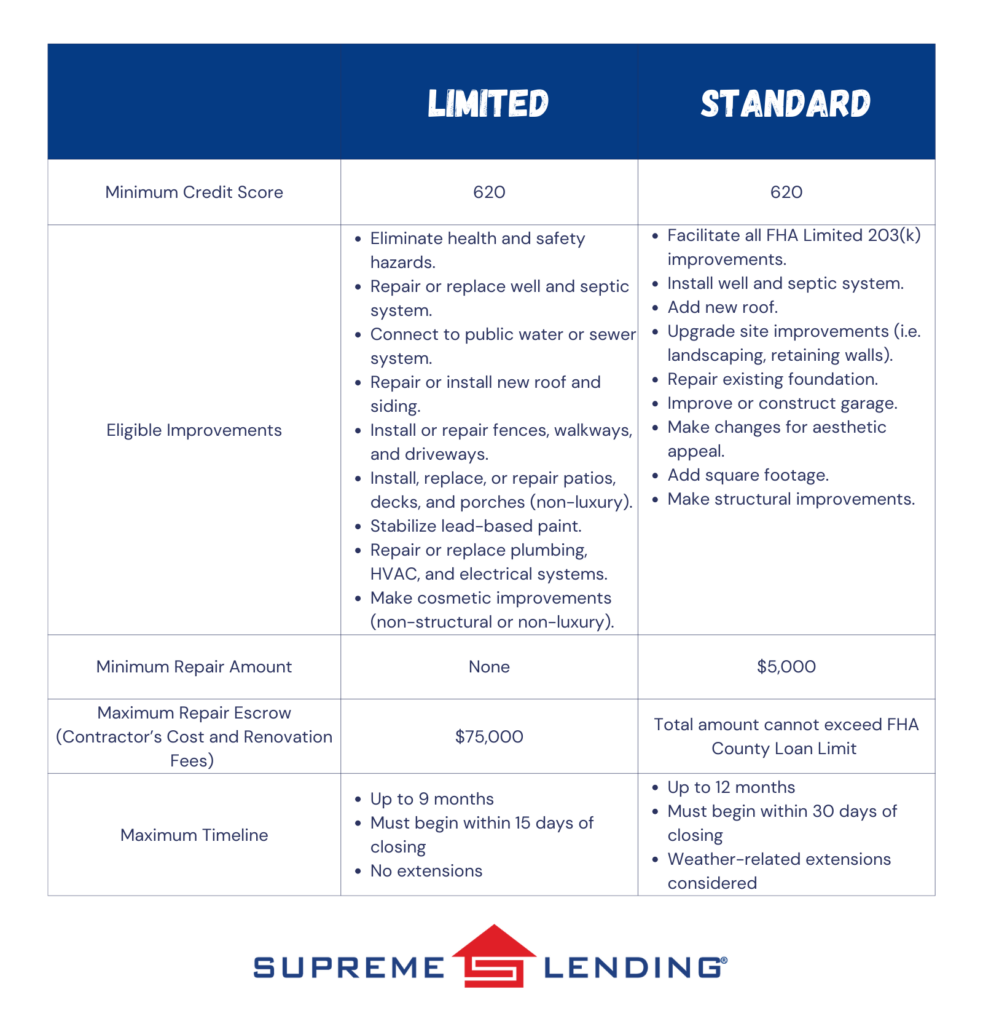
Limited vs. Standard FHA 203(k) Renovation Loan
There are two types of FHA 203(k) loans—Standard and Limited. Each has specific uses and limits depending on the scope of renovations you can make.
Limited FHA 203(k) Loan
The Limited 203(k) option is commonly used for smaller repairs and cosmetic upgrades. As mentioned, the loan amount will increase to $75,000 in November 2024, an exciting enhancement that will help open the door to renovations for more people. This loan covers non-structural projects such as remodeling kitchen fixtures, replacing flooring, painting, and minor landscaping. Unlike the Standard, the Limited program doesn’t require working with an HUD consultant or have a minimum loan amount.
Common Projects the Limited Covers
- Minor remodeling (i.e. updating kitchens or bathrooms)
- Replacing appliances or flooring
- Repainting or refinishing surfaces
- Energy-efficient improvements (i.e. installing new windows or insulation)
- Repairing roofs and gutters
Standard FHA 203(k) Loan
The Standard FHA 203(k) Renovation loan is more ideal for homes needing larger renovations and structural repairs. These may include adding rooms, replacing outdated plumbing or electrical systems, and fixing major structural issues. It has a minimum of $5,000 that must be used for renovations and the total loan amount must be within the FHA County Loan Limit. Because these projects are typically more complex, you’re required to work with an HUD-approved consultant.
Common Projects the Standard Covers
- Structural repairs or additions (i.e. adding on square footage or fixing foundation issues)
- Major systems replacements (i.e. plumbing, electrical, or HVAC systems)
- Roof repairs or replacements
- Modernization and improvements to the home’s function
- Accessibility improvements for people with disabilities
How Does the FHA 203(k) Renovation Loan Work?
The process for applying for an FHA 203(k) loan is similar to a regular FHA mortgage but comes with a few additional steps. Here’s an overview of how this loan program works.
- Find a property. Whether it’s a home you already own and want to refinance* or one you’re planning to purchase, identify a property that needs renovations.
- Get an appraisal. The home appraisal will assess both the home’s current market value as well as it’s “as-completed” value after the renovations are completed.
- Contractor and Estimates. Work with a licensed contractor to obtain the estimated costs for the repairs and improvements.
- Loan Application. You’ll apply for the loan based on the combined cost of the home and repairs.
- Renovation Timeline. Once the loan is approved, the renovation funds are placed into an escrow account and work begins. The renovation timeline can typically range from six months to one year.
*By refinancing an existing loan, total finance charges may be higher over the life of the loan.
FHA 203(k) Combined with FHA 203(h) Disaster Relief Loan
Did you know that eligible borrowers affected by federally declared disaster areas may be able to combine the FHA 203(k) renovation loan with the FHA 203(h) disaster relief loan? This means adding the renovation costs into a new mortgage if your home was destroyed and deemed unlivable. Plus, the damaged property is eligible regardless of the age of the home. It only needs to have been a habitable residence prior to the disaster.
Ready to Rebuild?
At Supreme Lending, we understand how important it is to transform a home into one that truly meets your needs. Whether you’re fixing up a new property or renovating your current home, the FHA 203(k) renovation loan offers an excellent way to finance those improvements. We’re proud to offer both Standard and Limited options to fit the scope of your home projects.
Want to learn more about FHA 203(k) renovation loans or other mortgage options? Contact our team at Supreme Lending today and get pre-qualified!
Looking for other renovation loan options? Read more: