
by Supreme Lending | Dec 8, 2024

Whether currently married homeowners or soon-to-be married, it’s important to understand the homeownership rights when it comes to spouses and the state they reside in. Let’s breakdown spousal states versus community property states and how they impact the mortgage process for married couples.
Spousal States
In spousal states, which includes 41 states and the District of Columbia, common law property is used to determine homeownership of married couples. This means, if only one member of the married couple buys a home or acquires a property, it belongs solely to that person unless the property is specifically put in the names of both spouses.
However, when purchasing or refinancing a home, the other spouse who is not involved in the mortgage will still need to sign various legal closing documents to acknowledge they know about the loan but are not financially responsible for it. In the event of a divorce under these circumstances in a spousal state, the marital property would be divided in a way that is fair but not necessarily equal 50-50, which is called equitable distribution.
For the other spouse to be added to the mortgage and gain ownership rights, they will typically need to refinance.
Community Property States
When a married couple buys a new home or refinances in a community property state, both spouses are financially responsible for the mortgage, even if an individual isn’t listed on the loan. Therefore, both parties will need to be involved in the loan closing. These states include Arizona, California, Idaho, Louisiana, Nevada, New Mexico, Texas, Washington, and Wisconsin.
Community property states allow a 50-50 split of homeownership for marital property and assets, including debt. This means one spouse’s debt may impact the Debt-to-Income (DTI) ratio when applying for a mortgage together.
To learn more about mortgages for married couples or other home financing information, contact your local Supreme Lending branch or connect with us today.

by Supreme Lending | Nov 19, 2024

Refinancing* your mortgage may be a strategic financial move that may unlock potential savings, but a common question for homeowners is, how soon can you refinance? Timing is everything. Whether you’re looking to lower your monthly mortgage payments, pay off your home loan quicker, or tap into your home equity for extra cash, knowing when to refinance is important. Let’s dive into the basics of refinancing, how soon you can refinance depending on the loan type, and how to determine the ideal time to consider the option.
Understanding the Basics of Refinancing
Refinancing involves taking out a new mortgage with different terms and using it to pay off your existing loan. The process may result in various benefits:
- Lower Interest Rates. If market conditions cause rates to drop since you purchased your original home loan, refinancing at a lower rate may lead to significant savings over the life of the loan.
- Reduce Monthly Payments. Securing a lower interest rate or a longer loan term may also decrease your monthly mortgage payments.
- Shorter Loan Term. If you can pay off your mortgage much sooner due to an increase in income, for example, it may make sense to refinance into a shorter term.
- Switch Loan Type. If you initially choose an Adjustable-Rate Mortgage, also known as an ARM loan, you may be able to refinance into a fixed-rate loan before the ARM rate adjusts. This may save you interest costs in the long run.
- Cash Out on Your Equity. When refinancing, you might opt for a cash-out refi loan. This allows you to tap into your equity, which is the portion of your home’s value that is yours.
- Payoff Higher-Interest Debts. You can use the cash from your equity to pay other debts such as high-interest credit cards, car loans, or student loans.
- Eliminate Private Mortgage Insurance. In some cases, you may have to pay a monthly fee for mortgage insurance. Once you reach a certain equity threshold, some lenders allow you to remove the private mortgage insurance by refinancing.
Timing Guidelines Based on Loan Type
The timing for when you can refinance your home depends on the lender and type of loan. It’s common for mortgage refinances to require a waiting period, or a seasoning period. Here are some general guidelines on how soon you can refinance a mortgage:
Conventional Loans
For conventional loans, most lenders require at least six months from your original closing date before you can refinance. This waiting period allows lenders to assess your payment history and ensure that you’re not a high-risk borrower. If you use another lender to refinance, you may be able to do a rate-and-term refinance without a seasoning period.
FHA Loans
For FHA loans, which are insured by the U.S. government’s Federal Housing Administration (FHA), you may be able to get an FHA Streamline Refinance. This simplifies the process and requires less documentation. However, you can’t get a streamline refinance until after 210 days from the closing date. You must also have made at least six months of on-time payments.
VA Loans
Similar to FHA, VA loans also offer a streamlined refinancing option known as an Interest Rate Reduction Refinance Loan (IRRRL). You’ll have to wait 210 days from the closing date of your existing VA loan and make six consecutive on-time payments to be eligible.
USDA Loans
These types of loans for rural areas are similar to those of FHA and VA loans. You’ll typically need to wait for 180 days or 12 months (depending on the type of refinancing) and establish a history of making on-time payments for the past six months to one year depending on the program.
Cash-Out Refi Loans
Additionally, how soon can you refinance with a cash-out refi? For this option, you typically need to have occupied the home as a primary residence for at least 12 months.
Why Timing Matters
Prepayment Penalties and Other Fees
A mortgage prepayment penalty is a fee charged by lenders if you pay off your mortgage early. Essentially, this helps compensate lenders for the interest income they lose when the loan is paid off early. When refinancing, it’s important to know if your current mortgage has a penalty or other fees associated to paying off the loan early. The cost of the fee may outweigh the benefits of refinancing.
Down Payment Assistance
Additionally, if you used down payment assistance for your current mortgage, check the terms of that aid. For some programs, refinancing too soon might require you to repay the assistance amount. Other programs may even require repayment of the down payment assistance amount when you refinance regardless of how long you’ve had the loan. This could impact any potential savings from refinancing.
Best Practices and Considerations
When deciding whether it’s a good time to refinance, here are a few things to keep in mind:
- Interest Rates. Monitor the rate and market trends if your primary goal is to refinance with a lower interest rate. You can always reach out to your local loan officer at Supreme Lending to help determine what your potential refinance rate may be.
- Closing Costs. Just like a traditional mortgage, refinancing includes closing costs that can range from 2% to 6% of the loan amount. Be prepared so you’re not surprised at the closing table.
- Break-even Point. Calculate the break-even point by determining when the costs of refinancing will be outweighed by the potential savings. Basically, it’s when your investment in refinancing will start to pay off.
- Loan Term. Consider whether you want to shorten your loan term to save on interest over the life of the loan or extend it for potentially lower monthly payments.
- Credit Score. A stronger credit score may qualify you for more favorable rates, so it’s worth monitoring your credit and making regular, on-time payments.
- Financial Goals. One of the most important aspects of refinancing is to make sure that a refinance aligns with your short- and long-term financial goals. Are you looking to minimize other debts, invest in renovations, or change your loan type?
Is Now the Right Time to Refi?
So how soon can you refinance your mortgage? Ultimately, it comes down to the loan-specific guidelines and your personal financial goals. It’s essential that you are well-informed, understand the refinancing process, and know all the factors that will go into your new refinanced loan. At Supreme Lending, we’re committed to helping you navigate your refinancing journey with ease and confidence.
*By refinancing an existing loan, total finance charges may be higher over the life of the loan.

by Supreme Lending | Nov 10, 2024
Your Quick Home Appraisal Checklist

When buying or selling a home, it’s important to understand the importance of a home appraisal during the mortgage process. Appraisals determine the value of a property based on various factors, ensuring buyers, sellers, and lenders are aligned on what the home is worth. Knowing what appraisers look for can help ensure a smooth mortgage process and avoid last-minute surprises or delays. Read on for an overview of the appraisal process including a home appraisal checklist for homeowners, buyers, and real estate agents to consider.
What Is an Appraisal?
An appraisal is an independent assessment of a property’s market value led by a licensed appraiser. The value is based on evaluating several aspects of the home, such as the condition, location, and recent sales of comparable properties in the area. The appraisal is an essential step of the mortgage process required by most lenders to verify that they’re not lending more than the home is worth. For buyers, a home appraisal can also offer reassurance that they are paying a fair price.
The Home Appraisal Checklist: What Appraisers Look For
Here’s a quick look at some key elements appraisers may consider when evaluating a property. You can use this guide when searching for a home or preparing to sell.
1. Home Size and Layout
- What is the total square footage and number of bedrooms and bathrooms?
- Is the layout of the rooms and spaces functional.
- Is there a finished basement or attic that adds to the livable space?
2. Exterior Condition
- Roof: Are there any missing shingles, leaks, wear and tear, etc.?
- Foundation: Are there visible cracks or settling issues?
- Siding, windows, and doors: Check for any damage, peeling paint, or outdated fixtures.
- Landscaping: Is it overgrown or neglected?
3. Interior Condition
- Walls, ceilings, and floors: Are there any cracks, stains, or general wear and tear?
- Kitchens and bathrooms: Is there any damage, outdated appliances, or broken equipment? Are there luxury upgrades that may boost the home’s value?
- Plumbing and electrical: Are the systems up-to-code, functional, and safe?
4. Lot Size and Usability
- How large is the lot?
- Is it safe and functional?
5. Upgrades and Amenities
- Are there any recent home improvements, such as a kitchen remodel, energy-efficient updates, or a new roof?
- Are there unique amenities such as a pool, outdoor kitchen, or wine cellar?
6. Safety and Compliance
- Appraisers will check for safety hazards or code violations.
- Factors like missing handrails, faulty wiring, or broken windows can negatively impact the appraisal.
7. Location & Neighborhood
- Appraisers will examine the property’s location, including proximity to schools, parks, shopping centers, and other amenities.
- Neighborhood conditions, crime rates, and overall desirability can also impact the value.
8. Comparable Sales (Comps)
- Appraisers will compare the home to the sales of similar properties in the neighborhood.
- Factors such as home size, condition, and location are considered to provide a rough benchmark.
Preparing a Home for an Appraisal: Tips for Sellers and Agents
Keeping the home appraisal checklist in mind, there are some measures that sellers or listing agents may consider to prepare for an appraisal and potentially maximize a home’s value.
- Make Minor Repairs As Needed. Fix any small but noticeable issues, such as leaky faucets, old paint, stained carpet, and broken hardware. Minor fixes may go a long way in improving a home’s appraisal value.
- Clean and Declutter. A clean, organized home allows the appraiser to focus on the property’s key features rather than clutter. This step can also enhance the home’s overall appearance.
- Highlight Recent Upgrades. If the home has undergone significant improvements, provide the appraiser with a list of updates, including the dates and cost of renovations.
- Provide Easy Access. Make sure that the appraiser can navigate to all areas of the home, including the basement, attic, and other outdoor structures.
Frequently Asked Questions About Appraisals
1. What is the difference between a home appraisal and a home inspection?
A home appraisal determines the market value of the property, which is essential for lenders to approve the loan amount. A home inspection, on the other hand, assesses the condition of the home and identifies any potential issues or repairs that may need to be addressed. While an appraisal focuses on value, an inspection focuses on the home’s livability.
2. What happens if the home appraises for less than the sale price?
If the appraisal comes in lower than the agreed-upon sale price, the buyer and seller may need to renegotiate. The buyer could request the seller to lower the price, or the buyer may need to pay the difference out of pocket.
3. Do you need an appraisal when refinancing?
Yes. When refinancing,* it’s essential to understand the home’s current market value, especially if you’re taking cash out of your home equity. The appraisal also plays a key role in determining the Loan-to-Value ratio, which can affect loan terms, interest rate, and whether private mortgage insurance may be required.
*By refinancing an existing loan, total finance charges may be higher over the life of the loan.
What’s Next?
A home appraisal is one of the most important steps in the mortgage process. Once the appraisal is complete, the report is submitted to the lender for review. The lender reviews the appraisal report to verify the property’s appraised value aligns with the loan amount. When all loan conditions are met, it’s smooth sailing to closing.
Whether buying, selling, or listing a home, understanding the home appraisal checklist can help make the mortgage process smooth and seamless.
For more information about mortgages and steps of the loan process, contact your local Supreme Lending team today!
Related articles:

by Supreme Lending | Nov 9, 2024

You’ve submitted your initial mortgage application, completed the necessary paperwork, and even had your home appraised. Now, you find yourself at the crucial stage of the loan process – underwriting. This is where the underwriter, acting as a gatekeeper for the lender, meticulously assesses your financial details to determine the risk of financing your home. In this article, we will explore the mortgage underwriting process, its significance, and what borrowers can expect during this critical phase.
Who Are Underwriters and What Do They Do?
Underwriters play a pivotal role in safeguarding the interests of the lender during the home loan process. Their primary responsibility is to assess your ability to repay the loan and evaluate the risk associated with lending money to you. They review various aspects of your financial profile, including your credit score, income, and the appraised value of the property. The goal is to ensure that borrowers are not taking on more mortgage responsibility than they may be able to handle.
Importance of Underwriting:
The housing crisis of 2008 highlighted the need for stricter underwriting guidelines. Loose regulations during that period allowed borrowers to access funds without adequate means to repay, resulting in widespread defaults. Today, underwriters adhere to stringent guidelines to help prevent the recurrence of such crises, protecting both borrowers and lenders alike.
What to Expect During the Underwriting Process:
Further Paperwork May Be Needed:
During the underwriting process, underwriters may request additional documentation to gain a comprehensive understanding of your financials. It’s crucial to provide any requested documents promptly to keep the mortgage process moving smoothly.
Turn-times Vary:
Depending on the loan type and market conditions, the underwriting process may take anywhere from 5 to 14 days. Understanding the potential timeline may help you manage expectations and plan accordingly.
Disclosure Mailings:
Borrowers may receive electronic or paper loan disclosures throughout the process. These disclosures are sent to ensure compliance with state and federal laws.
Loan Determinations:
After reviewing your application, the underwriter will issue one of three determinations:
Conditional Approval of Loan:
Your loan is cleared for funding, and your lender will discuss any remaining conditions specified by the underwriter. A closing date will be scheduled.
Suspension of Loan:
A suspension occurs when there are questions about a critical facet of your loan file. Your lender will work with you to identify and address any concerns, leading to a potential conditional approval.
Denial of Loan:
If your file indicates a high level of risk, the underwriter may deny the loan based on industry benchmarks, not personal intuition. For example, perhaps there was a significant drop in your credit score, indicating potential payment inconsistencies and a big risk for a lender.
What Happens If Your Loan Is Suspended or Denied?
Choosing the right lender is crucial, and at Supreme Lending, the relationship doesn’t end if your loan faces challenges. Supreme’s dedicated team may be able to help overcome underwriting objections, identify errors, and work with you to improve your application.
Understanding the mortgage underwriting process is vital for borrowers navigating the complex world of home loans. As you approach this final checkpoint, being prepared for potential requests for additional documents, varying turn times, and the possible outcomes of the underwriting review can help streamline the process. With Supreme Lending by your side, you can navigate the underwriting process with confidence and increase the chances of a successful loan closing.
Dos and Don’ts During the Mortgage Underwriting Process
The journey to homeownership involves various stages, and one of the most important steps is the mortgage underwriting process. This phase determines whether your loan will be approved or not. To ensure a smooth underwriting experience with Supreme Lending, it’s essential to follow a set of Do’s and Don’ts.
Do’s:
Maintain Consistent Debt Payments:
Make minimum monthly payments on your consumer debt until the loan closes. Any deviation from this may have adverse effects on your mortgage application.
Timely Mortgage Payments:
Ensure your mortgage payments are made on time and are no more than 15 days late. Any delay beyond this timeframe may pose risks to your loan approval.
Cooperate with the Title Company:
Respond to calls from the Title Company. Occasionally, there may be outdated or unreleased liens, which can complicate the ownership of your property. Addressing these issues promptly is vital for clearing your property’s title in preparation for closing.
Submit Requested Documents Promptly:
Provide any documents requested by Supreme Lending immediately. Timely submission is crucial, as documents can have expiration dates, and delays may affect your application.
Retain Financial Documents:
Hold onto electronic and paper copies of pay stubs, bank statements, and other financial documents until the loan closes. You may be required to provide them during the underwriting process.
Don’ts:
Avoid Job Changes or Retirement:
Refrain from resigning or retiring during the loan process without consulting your Supreme Lending mortgage expert. Changes in employment status may impact your loan approval.
No New Credit Accounts:
Do not open or apply for new credit accounts before your mortgage loan closes. New accounts or inquiries can be easily identified during underwriting and may jeopardize your application. Our experienced professionals understand that life happens, and should a need arise for situations such as applying for student loans or financing a child’s upcoming college tuition, we ask that you discuss your plans with a member of our team before you take action.
Avoid Balance Transfers:
Refrain from making balance transfers on existing credit card balances. Such actions may slow down the mortgage application process.
Don’t Pay Off Existing Credit Accounts in Full:
Avoid paying off existing consumer credit accounts (e.g. auto loans, credit cards, etc.) in full unless it aligns with the natural progression of making minimum monthly payments.
Successfully navigating the mortgage underwriting process requires careful attention to detail and adherence to specific guidelines. By following the Do’s and Don’ts outlined above, you may increase the likelihood of a smooth and successful loan approval. If you have any questions or concerns about your loan, don’t hesitate to reach out to the Supreme Lending team for assistance. Remember, open communication and timely action are key to a positive mortgage underwriting experience.

by Supreme Lending | Nov 7, 2024
For aspiring homeowners and first-time buyers, many questions can arise about the mortgage process. What credit score do you need to qualify? How much down payment is required? Answers are based on several factors including the property, purchase price, and, most importantly, the mortgage type.
Here’s a breakdown to simplify the numbers and help you understand what you need to open the door to your dream home depending on common mortgage types: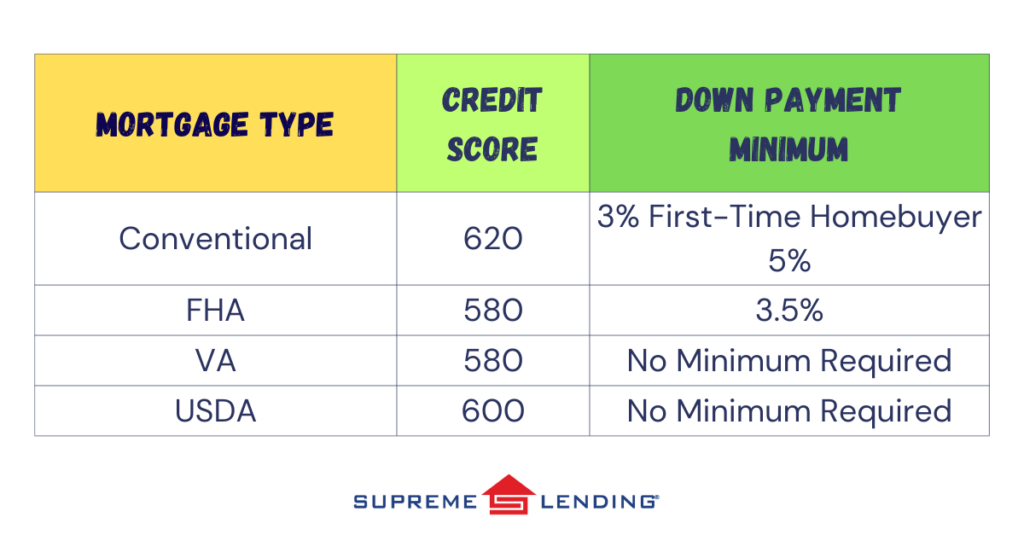
What Is a Credit Score?
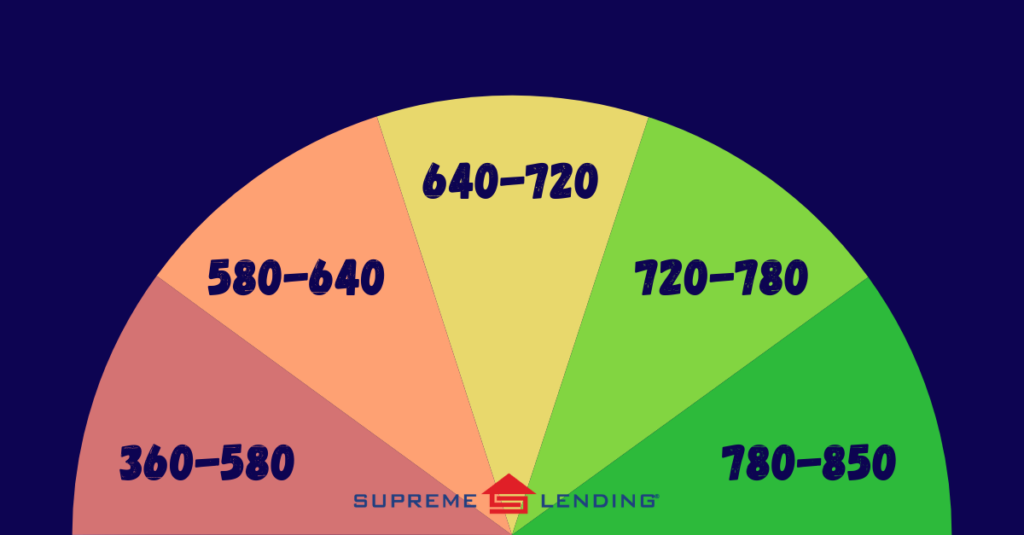
Commonly determined by FICO® score, credit scores are calculated using the borrower’s financial background information such as payment history, credit utilization, length of credit history, types of credit in use, and recent credit behavior. The average credit score in the United States in 2023 was 715, according to Experian data.
Down Payment Assistance Options
If a homebuyer doesn’t have the required minimum down payment or would like to access more financing, Supreme Lending offers several down payment assistance options for qualified buyers. This can also help first-time buyers open the door to homeownership. Guidelines and eligibility vary depending on the program. For example, the Supreme Dream program offers down payment assistance in the form of a fully forgivable second loan and requires a minimum credit score of 620. Ask your Supreme Lending Loan Officer about qualified assistance programs.
Understanding credit score and down payment requirements for different types of mortgages is crucial for prospective homebuyers. While each loan type has its own guidelines, maintaining a good credit score and having sufficient funds for upfront costs at closing remains a common denominator for securing favorable terms and interest rates. By proactively managing your credit and staying informed about your options, you can navigate the mortgage process with confidence on your journey to homeownership.
Contact your local Supreme Lending branch to get pre-qualified and learn about your home financing options.