
by Supreme Lending | Nov 3, 2024
An Overview of Supreme Lending Credit Score Requirements

When you’re preparing to buy a home, understanding the mortgage credit score requirements is essential. Your credit plays a significant role in determining your eligibility for various loan programs, as well as interest rates you may qualify for. Our goal at Supreme Lending is to provide the smoothest mortgage experience possible, that includes guiding you with transparent information to help you to make an informed, confident decision. Here’s an overview of Supreme Lending’s credit score requirements for common loan programs and frequently asked questions.
Conventional Loans
Conventional loans are popular among homebuyers due to their flexibility and competitive interest rates. As a general rule of thumb, Supreme Lending requires a minimum credit score of 620 for Conventional loans. However, a higher score typically results in securing more favorable rates and terms.
FHA Loans
Insured by the Federal Housing Administration, FHA loans are another common mortgage option –especially for first-time homebuyers or borrowers with lower credit. These loans have more lenient credit score requirements, accepting as low as 580.
VA Loans
For eligible military Veterans and active-duty personnel, VA loans offer affordable options as they don’t require a down payment or mortgage insurance premiums. Like FHA loans, Supreme Lending’s credit score requirement for VA loans is a minimum of 580.
USDA Loans
Guaranteed by the U.S. Department of Agriculture, USDA loans provide affordable financing designed for homebuyers in designated rural areas with no down payment required. In general, Supreme Lending’s credit score requirement for this program is 600.
Jumbo Loans
Jumbo loans are used to purchase high-value properties with a loan amount greater than conforming loan limits, which is $766,550 for one-unit homes in 2024. Due to potential higher lending risk, Jumbo loans typically have stricter qualifications. Supreme Lending has jumbo programs with a minimum credit score of 680, but depending on the loan guidelines, some may require at least a 720 credit score or higher.
Frequently Asked Questions
Now that you have a snapshot of common credit score requirements at Supreme Lending, here’s some more insight on how your credit can impact your mortgage.
How is a credit score determined?
A credit score, often represented by a FICO® score, is a numerical assessment of a borrower’s financial health. It is calculated based on several key factors:
- Payment History: Your record of on-time payments versus late or missed payments.
- Credit Utilization: The amount of credit you’re using compared to your total credit limits.
- Length of Credit History: The duration of time you’ve had credit accounts open.
- Types of Credit in Use. The variety of credit accounts you have, such as credit cards, mortgages, and car loans.
- Recent Credit Behavior. This includes how many new credit accounts you’ve opened recently and credit inquiries.
Combining these factors provides a numerical score to help reflect your creditworthiness.
What qualifies as a generally “good” credit score?
In general, a credit score of 670 to 739 is considered good according to FICO® standards. Scores in this range suggest that you are a responsible borrower with a solid history of managing credit well. 740 or higher is considered very good or exceptional. Remember, a higher the credit score usually results in more favorable mortgage rates and terms.
Additionally, a credit score between 580 and 669 is considered fair. This range aligns with many of the credit score requirements outlined above depending on the loan type. So don’t fall victim to the common mortgage myth that you need perfect credit to qualify for a home loan.
What’s the difference between a soft credit pull and hard credit pull?
When applying for a mortgage, lenders need to pull your credit report. There are two ways to do this:
- A soft credit pull is a credit check that doesn’t affect your credit score. It’s typically used for pre-qualifications or when you check your own credit. Supreme Lending has this option when you get pre-qualified for a mortgage.
- A hard credit pull, on the other hand, occurs when a lender reviews your credit score as a formal credit application during the loan approval process. Hard pulls can temporarily lower your credit score by just a few points. However, there’s no significant impact, which is another mortgage myth to debunk.
Here to Help
Don’t navigate the mortgage process alone! Our experienced and knowledgeable team at Supreme Lending is here to help you understand all aspects of your homebuying journey. From understanding credit score requirements and determining which loan program may work for you to our seamless underwriting process, we help you close your loan with confidence.
Contact us today to get started!
Related articles:
Common Credit Score and Down Payment Requirements by Mortgage Type
FHA Loans vs. Conventional Mortgage: Which One Is Right for You?

by Supreme Lending | Nov 1, 2024

There are several important steps involved in the homebuying process, and an independent confirmation of the property’s value is a key step for mortgage approval. This evaluation is typically known as an appraisal. What is an appraisal, why is it done, and what else do you need to know about the appraisal process as a prospective homebuyer? Here are the basics.
What’s an Appraisal?
For those who have never been through the mortgage process before, an appraisal refers to an unbiased estimate of a home’s value. A professional appraiser evaluates the property to confirm its worth, which is then used to determine how much money can be loaned to the borrower through a mortgage.
In nearly all home purchases today, lenders require an appraisal before approving a loan. This is because they want to be confident that they’re not loaning more money than the property is worth, as this would put them at risk of loss if the borrower defaults on the loan.
Generally, appraisals are completed and filed within the jurisdiction in which the property is located. This is important to keep in mind if you’re considering a purchase in another city, county, or state, as different jurisdictions have different requirements and processes.
Why Are Appraisals Important?
As mentioned, appraisals play a vital role in the homebuying process as they provide an unbiased estimate of a property’s value. This number becomes incredibly important when negotiating a purchase price, as it can help confirm or refute the asking price set by the seller.
If you’re planning to obtain a mortgage to finance your home purchase, the appraisal value will also be used to determine how much funds you’re eligible to borrow. In some cases, the appraised value may be lower than the agreed-upon purchase price, meaning that the buyer would need to come up with the difference in cost.
Of course, it’s important to remember that appraisals may not always be 100% accurate. There is some subjectivity involved in the process, and different appraisers can sometimes come up with different values for the same property. That’s why it’s important for buyers to be aware of recent comparable sales in the area, as this can help them gauge whether or not an appraisal is fair.
What Do Appraisers Look for?
When an appraiser is assessing a property, they’ll be looking at several different things. Here’s a general list:
- Interior and exterior inspection: The appraiser will visit the property and conduct a thorough inspection, taking note of both the condition of the property and any features or amenities that may impact its value. This will cover both the interior and exterior of the property.
- Review of recent sales: The appraiser will also review recent sales of comparable properties in the area to get an idea of the current market value. These will be included in the appraisal report for review, along with a street map that shows the locations of those properties.
- Assessment of the property’s condition: The appraiser will also provide their opinion on the condition of the property, which can impact its value. Therefore, it’s important for sellers to make necessary repairs or improvements before putting their home on the market.
- Square footage calculation explained: Assessing square footage is another essential part of the appraisal process. The appraiser will determine the total square footage of the property as well as the livable space. This can sometimes be tricky, as there are different ways to measure square footage and some methods may result in a larger number than others. For this reason, appraisers are generally required to also include the method they used in determining the home’s square footage on the report.
- Photos: One of the most important parts of the appraisal report is the photos that the appraiser takes during their inspection. These provide a visual record of the property’s condition and can be helpful when reviewing the report.
The appraiser’s findings are presented in reports that typically are several pages and include other important information, such as the appraiser’s qualifications, contact information, and any licenses or certifications they may have.
Who Pays for Appraisal Costs?
Generally speaking, appraisals can run between $300-$700 for single-family homes, though the exact cost will depend on the appraiser and the property being assessed. In most cases, the buyer is responsible for covering the cost of the appraisal, though there are some instances where the seller may agree to pay. Homebuyers may have the option to roll the appraisal cost into their closing costs or possibly the mortgage itself.
For more information on the appraisal process, or to learn more about any of our mortgage products and services, contact your local Supreme Lending team today.
Related Articles:
by Supreme Lending | Oct 31, 2024
All You Need to Know About the VA Loan Funding Fee

Military veterans and active-duty service members have dedicated their lives to serving our country, and Supreme Lending couldn’t be more grateful for their service. When it comes to homeownership, there’s no one more deserving than those who risk their lives to protect our freedom and safety. Supreme Lending is proud to offer the VA loan program. Backed by the U.S. Department of Veterans Affairs (VA), VA loans are designed to give eligible borrowers valuable home financing benefits, including no down payment requirement.
In this article, we’ll explore VA loans, eligibility, and, more specifically, the VA loan funding fee and how it works.
What Is A VA Loan?
A VA loan is a mortgage backed by the U.S. Department of Veterans Affairs. VA financing helps miliary veterans, active-duty service members, and certain members of the National Guard and Reserves become homebuyers. These loans offer several advantages, such as:
- No Down Payment Requirement. One of the biggest benefits of VA loans is that they allow you to purchase a home without a down payment. This makes homeownership for eligible military families more accessible with less upfront costs.
- Competitive Rates. VA loans often come with lower rates compared to Conventional loans, which may save money in interest over the life of the loan.
- No Private Mortgage Insurance. Unlike many Conventional loans that require Private Mortgage Insurance (PMI) when you put less than 20% down, VA loans don’t require this added cost.
- Repeat Buyers. Another unique benefit of VA financing is that it is not only for first-time homebuyers. Repeat buyers are accepted and second homes may be eligible under certain circumstances.
- Low VA Loan Funding Fee. The one-time VA loan funding fee is greatly lower than the typical down payment requirements. Below, we will outline the various funding fee percentages depending on the situation.
- Exemptions for Eligible Borrowers Available. There is an option to be exempt from paying the funding fee for qualified borrowers. For example, veterans who receive compensation for a disability related to their miliary service or active-duty members who received the Purple Heart.
Who Is Eligible for a VA Loan?
To qualify for a VA loan, you must meet specific eligibility guidelines. Generally, you must be a veteran, active-duty service member, or a member of the National Guard or Reserves. When applying for a VA loan, you must have a valid Certificate of Eligibility (COE). This demonstrates your service record and entitlement to VA loan benefits. Some surviving spouses of veterans may also qualify under certain circumstances.
What Is a VA Loan Funding Fee?
While VA loans offer incredible benefits, there is an important cost borrowers need to keep in mind: the VA loan funding fee. The fee helps to lower the cost of the loan for U.S. taxpayers since the VA home loan program doesn’t require down payments or monthly mortgage insurance.
Funding Fee Amounts
The amount of the funding fee varies based on the borrower, type of VA loan they’re getting, and how much down payment is being paid. First-time borrowers typically pay a lower funding fee compared to those who have previously used a VA loan
Click here for a breakdown of funding fees based on loan type.
Paying the Funding Fee
The VA funding fee is paid at closing. There are a few ways you may choose to pay the fee:
- Upfront Payment. Borrowers may pay the fee at closing, in full, which can be included as a closing cost.
- Finance Fee. Borrowers may also choose to roll the funding fee into their loan amount, allowing them to pay it over the life of the mortgage instead of upfront.
- Seller Concessions. In some cases, the seller may agree to cover the funding fee as part of the purchase agreement, providing additional assistance to the buyer.
Explore VA Loans from Supreme Lending
VA loans are a wonderful resource for military veterans and active-duty personnel looking to achieve homeownership. While there’s no down payment requirement, it’s essential to understand the VA loan funding fee. If you’re considering a VA loan or want to learn more about your home financing options, contact your local Supreme Lending branch today!
Related Articles:
by Supreme Lending | Oct 23, 2024

A reverse mortgage* is a unique loan designed to help eligible homeowners and homebuyers aged 62 or older convert some of their home equity into cash. This program may offer greater flexibility and financial independence, especially for those entering retirement. Reverse mortgages allow qualified senior homeowners to tap into their home’s value to meet other financial needs without having to sell their property or make monthly mortgage payments. What is a reverse mortgage, how does it work, and who may benefit from one? Here’s a breakdown.
What Is a Reverse Mortgage?
Reverse mortgages allow homeowners to borrow money using their home as security for the loan. Unlike traditional home loans where the borrower makes monthly payments to the lender, with a reverse mortgage, the lender makes payments to the homeowner. Reverse mortgages are experiencing a surge in popularity as more retirees may be considering them to supplement their retirement income.
How It Works?
The funds received with a reverse mortgage are based on the equity that’s been built in the home. Payments can be made to the homeowner in several ways:
- A lump sum
- A line of credit
- Fixed monthly payments
- A combination of all three options outlined above
The loan does not have to be repaid until the borrower sells or no longer lives in the home. However, the borrower must still meet all loan obligations including living in the house as a primary residence, keeping up with all property payments such as insurance and taxes, and maintaining the home’s condition.
What Can Reverse Mortgage Funds Be Used For?
A reverse mortgage may be a way for seniors to turn their home’s equity into cash to meet their financial needs while maintaining ownership of the property. The funds may serve various purposes, such as paying off other existing mortgages; covering healthcare, taxes, or insurance expenses; funding home renovations; and serving as a safety net for unexpected emergencies.
It may be an ideal option for seniors who:
- Want to stay in their home long-term.
- Need additional income to maintain their quality of life during retirement.
- Have significant equity built in their property but don’t want to sell or cash-out refinance** and take on monthly mortgage payments.
- Need to pay for in-house healthcare.
- Get a later in life silver divorce but want to stay in their home.
- Want to buy a home but are unable to pay all cash.
Frequently Asked Questions About Reverse Mortgage
1. Do I still own my home with a reverse mortgage?
Yes. When you obtain a reverse mortgage, you still retain ownership of your home. Your name remains on the title and the home is yours—just as it would be with any mortgage. You’re still responsible for paying property taxes, homeowners insurance, and maintaining the home.
2. When does the mortgage need to be repaid?
Once you no longer live in the home as your primary residence, the loan balance, including interest and fees, must be repaid. This is usually done by the homeowner or their estate that is selling the house
3. Will I owe more than my home is worth or leave my heirs with debt?
No. A HECM (Home Equity Conversion Mortgage) reverse mortgage is insured by the Federal Housing Administration. This insurance feature guarantees that you will never owe more than the value of your home when the loan becomes due. No debt will be left to your heirs. And if the loan balance is less than the market value of the home, the additional equity is retained by the homeowner or heirs if the home is sold.
4. What types of homes qualify for a reverse mortgage?
Single-family homes, FHA-approved condos, and multi-family homes (up to four units) are typically eligible, as long as the property is the borrower’s primary residence.
Supreme Lending’s Dedicated Reverse Mortgage Team
Want to learn more about reverse mortgages and explore your mortgage options? Supreme Lending is here to help you navigate your home financing. Additionally, in 2024, Supreme Lending launched a dedicated reverse mortgage division led by industry-leading veteran John Luddy NMLS #74875.
To learn more about this unique home financing option, contact John Luddy, SVP of Reverse Mortgage Lending, NMLS #74875 at (860)-883-6783.
*A reverse mortgage increases the principal mortgage loan amount and decreases home equity (it is a negative amortization loan). When the loan is due and payable, some or all of the equity in the property no longer belongs to borrowers, who may need to sell the home or otherwise repay the loan with interest from other proceeds. Lender charges an origination fee, closing costs and servicing fees (added to the balance of the loan). Monthly service fees are not assessed in Texas. The balance of the loan grows over time and Lender charges interest on the balance. The borrower must meet all loan obligations, including living in the property as the principal residence and paying property charges, including property taxes, fees, hazard insurance. The borrower must maintain the home according to FHA requirements. Failure to meet these requirements can trigger a loan default that may result in foreclosure. This material has not been reviewed, approved or issued by HUD, FHA or any government agency. The company is not affiliated with or acting on behalf of or at the direction of HUD/FHA or any other government agency
**By refinancing an existing loan, total finance charges may be higher over the life of the loan.

by Supreme Lending | Oct 17, 2024
Discover the Program Highlights of an FHA 203(k) Renovation Loan

Are you ready to turn a fixer-upper into your dream home? Whether it’s a home you’ve just bought or already own, renovation loans like the FHA 203(k) program may help you finance both the purchase and necessary repairs or updates all in one mortgage. Plus, the U.S. Department of Housing and Urban Development (HUD) announced that it is increasing the loan amount for Limited FHA 203(k) loans to $75,000 on all FHA case numbers effective November 4, 2024—that’s up from $35,000 which is huge news!
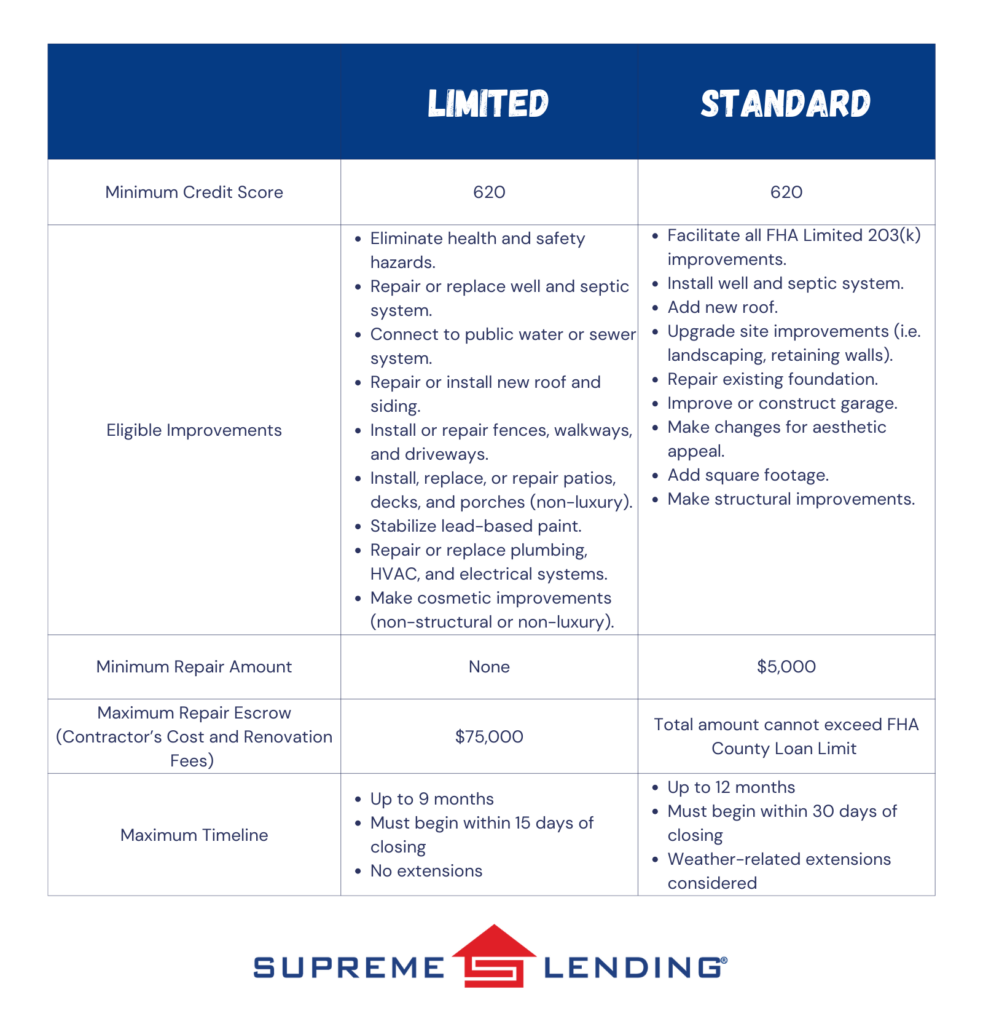
Here’s an in-depth look at how the FHA 203(k) renovation loan works, the differences between the Limited and Standard options, and what types of renovations may be covered.
What Is an FHA 203(k) Loan?
Insured by the Federal Housing Administration, the FHA 203(k) renovation loan allows homeowners to finance the cost of both the property and its renovations in a single loan. Whether you’re purchasing a home that needs updates or making repairs to your current home, this loan program may help make those dreams a reality. It offers the similar benefits of FHA loans for first-time buyers and repeat buyers alike. To qualify, eligible borrowers only need 3.5% down payment and there’s more lenient credit score requirements than other renovation loans.
Limited vs. Standard FHA 203(k) Renovation Loan
There are two types of FHA 203(k) loans—Standard and Limited. Each has specific uses and limits depending on the scope of renovations you can make.
Limited FHA 203(k) Loan
The Limited 203(k) option is commonly used for smaller repairs and cosmetic upgrades. As mentioned, the loan amount will increase to $75,000 in November 2024, an exciting enhancement that will help open the door to renovations for more people. This loan covers non-structural projects such as remodeling kitchen fixtures, replacing flooring, painting, and minor landscaping. Unlike the Standard, the Limited program doesn’t require working with an HUD consultant or have a minimum loan amount.
Common Projects the Limited Covers
- Minor remodeling (i.e. updating kitchens or bathrooms)
- Replacing appliances or flooring
- Repainting or refinishing surfaces
- Energy-efficient improvements (i.e. installing new windows or insulation)
- Repairing roofs and gutters
Standard FHA 203(k) Loan
The Standard FHA 203(k) Renovation loan is more ideal for homes needing larger renovations and structural repairs. These may include adding rooms, replacing outdated plumbing or electrical systems, and fixing major structural issues. It has a minimum of $5,000 that must be used for renovations and the total loan amount must be within the FHA County Loan Limit. Because these projects are typically more complex, you’re required to work with an HUD-approved consultant.
Common Projects the Standard Covers
- Structural repairs or additions (i.e. adding on square footage or fixing foundation issues)
- Major systems replacements (i.e. plumbing, electrical, or HVAC systems)
- Roof repairs or replacements
- Modernization and improvements to the home’s function
- Accessibility improvements for people with disabilities
How Does the FHA 203(k) Renovation Loan Work?
The process for applying for an FHA 203(k) loan is similar to a regular FHA mortgage but comes with a few additional steps. Here’s an overview of how this loan program works.
- Find a property. Whether it’s a home you already own and want to refinance* or one you’re planning to purchase, identify a property that needs renovations.
- Get an appraisal. The home appraisal will assess both the home’s current market value as well as it’s “as-completed” value after the renovations are completed.
- Contractor and Estimates. Work with a licensed contractor to obtain the estimated costs for the repairs and improvements.
- Loan Application. You’ll apply for the loan based on the combined cost of the home and repairs.
- Renovation Timeline. Once the loan is approved, the renovation funds are placed into an escrow account and work begins. The renovation timeline can typically range from six months to one year.
*By refinancing an existing loan, total finance charges may be higher over the life of the loan.
FHA 203(k) Combined with FHA 203(h) Disaster Relief Loan
Did you know that eligible borrowers affected by federally declared disaster areas may be able to combine the FHA 203(k) renovation loan with the FHA 203(h) disaster relief loan? This means adding the renovation costs into a new mortgage if your home was destroyed and deemed unlivable. Plus, the damaged property is eligible regardless of the age of the home. It only needs to have been a habitable residence prior to the disaster.
Ready to Rebuild?
At Supreme Lending, we understand how important it is to transform a home into one that truly meets your needs. Whether you’re fixing up a new property or renovating your current home, the FHA 203(k) renovation loan offers an excellent way to finance those improvements. We’re proud to offer both Standard and Limited options to fit the scope of your home projects.
Want to learn more about FHA 203(k) renovation loans or other mortgage options? Contact our team at Supreme Lending today and get pre-qualified!
Looking for other renovation loan options? Read more: